Vehicle Visions
You might be surprised at the volume and type of textiles being used in today’s vehicles – including woven, knitted and nonwovens. I, myself, have a Jeep, and I had to go look at it to see where fabric was used. Sure, we notice what seat covers are made of, but how many of you know whether your headliner is woven or nonwoven? And does it matter?
The truth is, I thought it looked woven – very tightly woven with fine thread – but Brad Kalil, director of market intelligence and economic insights for the Association of the Nonwoven Fabrics Industry, said today’s nonwovens can be made to look like woven fabric.
 A close look at a nonwoven fabric
Nonwoven fabric could provide business opportunities – perhaps not so much in the mass manufacturing arena, but certainly in customization of vehicles, which is growing in popularity. We “wrap” cars for many reasons; why not customize interiors as well?
First, let’s start with defining nonwovens. In September of 2018, we interviewed Phil Mango, a consultant in nonwovens for Smithers. He explained there are two primary nonwoven categories: disposable and durable. Since that time, of course, we have become all too familiar with disposable nonwovens, whether in the form of masks, wipes or other items the pandemic has forced upon us. Back then, diapers – for adults and babies – were the largest category of disposable nonwovens. Medical applications ranked third, behind wipes. That ranking appears to be the same today.
The other way to look at the market is by industry segment. It should be noted that many of these trends, including such things as lightweighting, also apply to other segments of the transportation industry.
There are about 220 nonwoven companies with over 900 nonwoven lines in North America, and some automotive component manufacturers, such as Autoneum, have their own nonwoven manufacturing lines as well.
According to Kalil, when much of the textiles industry decamped from North America to seek lower cost locations, the nonwoven industry never left. In fact, many took over textile factories that were abandoned in the exodus.
In a 2020 post by Design Pool, Amy Frascella from Land Rover explained that Jaguar/Land Rover aims to be a thought leader, “setting the taste of our time,” and notes that the design team has equal power with the engineering team, which is likely fairly unique in the industry.
“Looking ahead, Amy Frascella sees sustainability underpinning everything they do now. This means looking at their entire ethos differently. As a company, they truly embrace the responsibility to be more sustainable and more responsible from the very first steps in the design and engineering process. They are committed to looking at material development, post industrial and consumer waste, as well as their own waste streams during manufacturing with an eye toward minimal impact on the environment.”
This includes things like considering alternatives to leather, which is not sustainable, that can offer the luxury the company is known for.
Nonwovens Constitute a Growing Percentage of Today’s Autos
According to Kalil, nonwovens are lighter weight (important in helping improve gas mileage and performance of electric cars) and have better thermal and acoustic properties. Another reason is the fact that nonwoven lines are much faster than weaving lines.
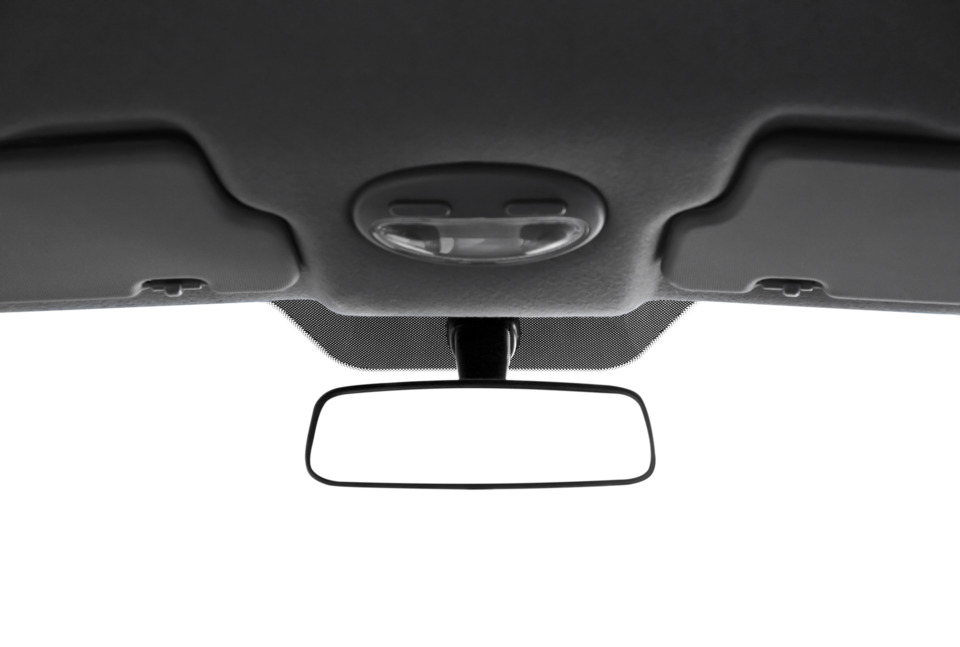
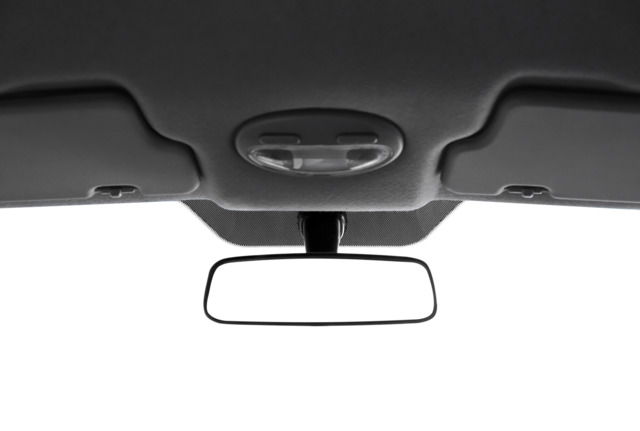 This auto headliner and sunvisors are covered with nonwoven material
Because of this, nonwovens are appearing in some surprising places. New, especially higher-end cars, according to Kalil, often use nonwoven material in the wheel wells and as a liner on the underside of the vehicle. This is due to their acoustic properties – they make for a quieter car than the plastic or metal that has been used in the past. Tesla also impregnates material in the nonwoven wheel well liner to prevent ice build-up.
Other things would not be so surprising – like the filters, battery separators, carpets, speaker covers, liners for the glove box and console storage areas. In fact, Mango identified 36 different areas where nonwovens are used in automobiles. And that doesn’t include wheel wells and the undercarriage.
Woven and knitted fabrics are also used in vehicles, sometimes for seat covers and other times for accents in a variety of areas.
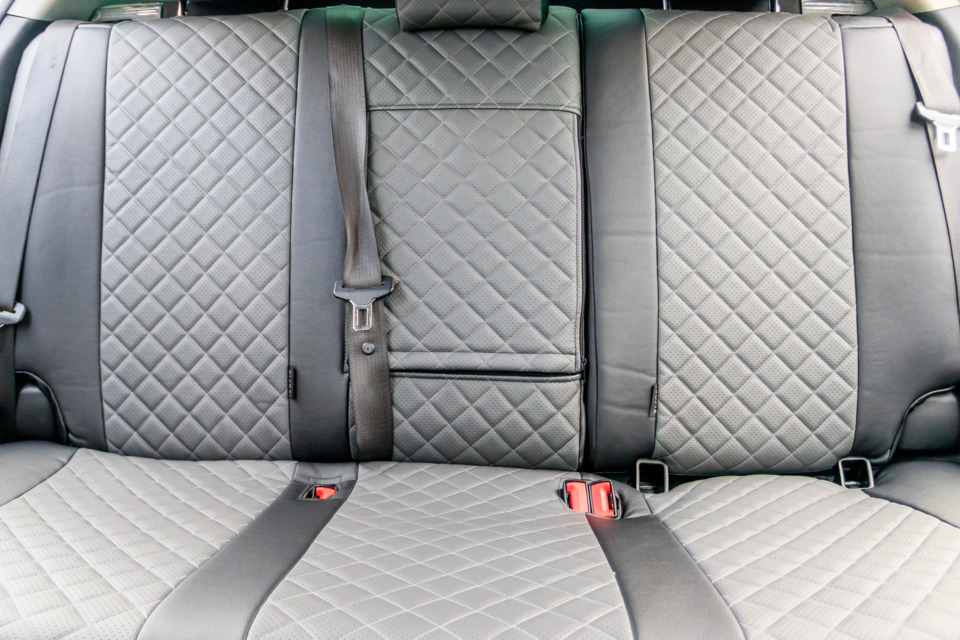
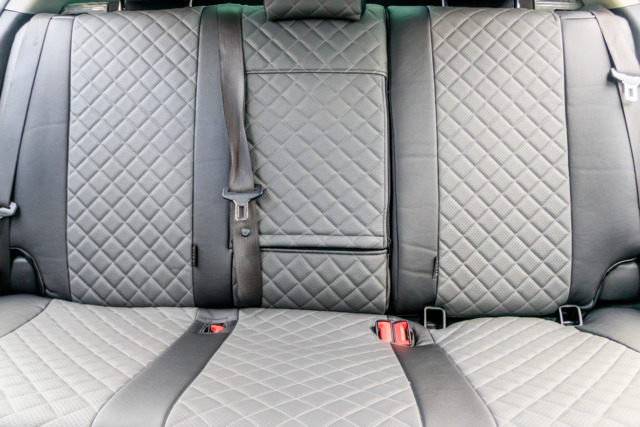 These seat covers are made of eco leather.
Manufacturing Nonwovens
There are many different ways nonwovens are manufactured, and most of these processes can also use recycled content, which is an environmental advantage. Web-forming processes include staple, melt-blown, spunlaid and needle-punched.
I found needle-punched to be particularly interesting in terms of the aesthetics of the material.
According to ScienceDirect.com, “Needle-punched nonwovens are felt-like and very flexible, having a fibrous network with distinctive pores, which makes them suitable for applications in filtration and drainage… needle marking caused by the punching effect of needles is frequently visible on the fabric surface.”
A variety of types of fibers can be used to create nonwovens, including recycled PET, rPET, etc. Both natural and manmade fibers, or a combination of the two, can be used, depending on the purpose of the nonwoven. One example of recycled materials being used in nonwovens for automotive is the use of carbon fiber materials that are manufactured for use in airplanes. When the holes are punched out for windows, etc., as a plane is being manufactured, that waste material used to be thrown away. These days, it is often ground up, made into fiber and used for many purposes. One example is a carbon fiber sunroof on some Mercedes vehicles. Flax is a common sustainable fiber used in Europe, and some BMW models feature a flax-based nonwoven liner or holder for the sunroof. Hemp is another natural fiber source that is being investigated as well.
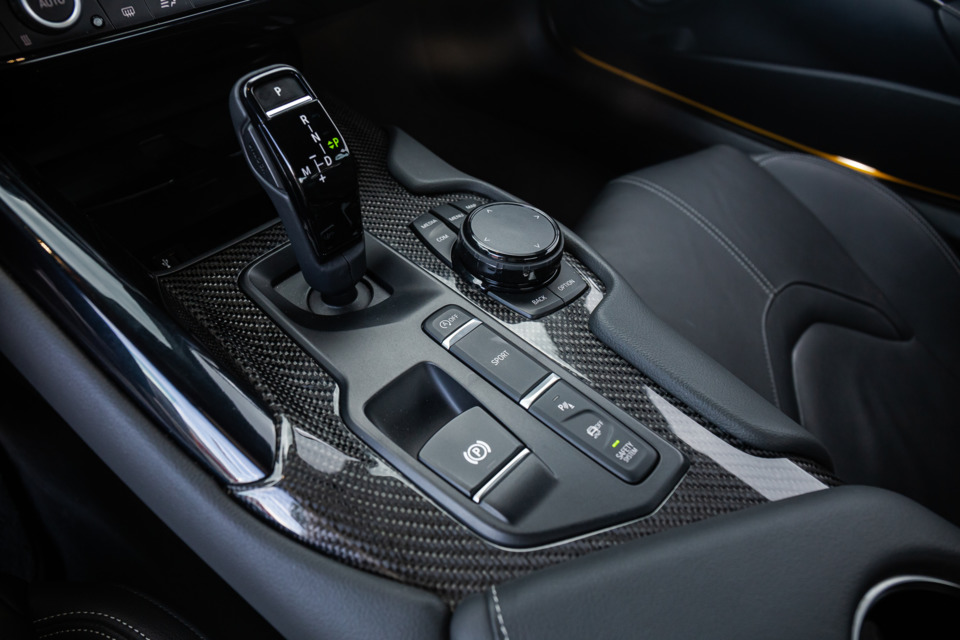
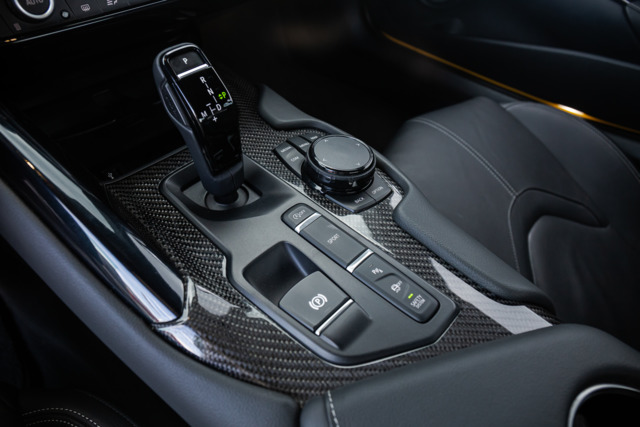 Carbon fiber nonwovens an be used as inserts in other parts of the vehicle
Automotive Recycling
Increasing focus is being placed on sustainability in the automotive industry, and as we have already mentioned, some nonwoven materials used in autos are made from recycled content, or fibers from renewable resources. But what happens to a vehicle at end of life?
Just about 80% of a vehicle (by weight) is recycled, and the remaining 20% that can’t be recycled is termed "auto shredder residue (ASR)," which includes ferrous and nonferrous metal pieces, dirt, glass, fabric, paper, wood, rubber and plastic.
 Auto recycling recaptures a growing volume of material for reuse
There are initiatives underway to deal with the ASR as well, including an Eastman Chemical project and a feasibility study being undertaken by PADNOS, a scrap recycling company.
Part of the issue with ASR is parts that are made of multiple materials that cannot easily be separated for recycling, carpet being a good example. These projects are looking for ways to do that, and at the same time, there is a movement within textiles to drive more use of mono-fiber materials that can more easily be recycled.
One company that is doing some work in that area is Borgstena, a subsidiary of the Dual Group, where Helen Scott is Head of Fabric Design for Borgstena Textiles NA LLC.
“The challenge for us is to promote a product where the face and backing utilize the same polymer so that at the end of the day, when it is taken out of the car, it can be recycled, broken back down into monomers and used again," she said.
She added that acrylic back coating for woven fabric has been an industry norm in North America for decades, which makes the entire seat cover unable to be recycled. However, in Europe they use a bi-laminate of foam and scrim which, if they were of the same polymer, would make recycling achievable. The majority of auto manufacturers are now requesting recycled content in the fabrics they use, especially for electric vehicles.
In a lot of this recycling effort, a significant amount of solvents are used, and projects are also underway to figure out how to recapture a greater percentage of those solvents for reuse.
For more information about nonwovens in general and their use in automotive and transportation, be sure to visit INDA.org and consider joining the association as well as attending its South Beach, Miami trade show next March.