
TechTextil 2019 Generates Inspiration, Excitement
Techtextil North America was a success by any measure. The show, which moved from Chicago to Raleigh N.C., drew more than 3,000 textile and apparel professionals and included an impressive symposium program. Here’s a quick summary.
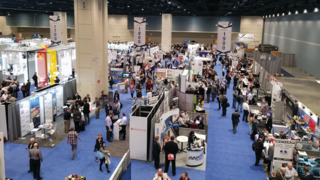
More than 3,000 textile and apparel professionals gathered in Raleigh, N.C., for TechTextil 2019, a much stronger attendance than Chicago in 2017—not surprising, really, since such much of the U.S. industry is centered in the Southeast. The event attracted 165 exhibitors, 91 of whom are new, demonstrating the vibrancy of the industry and the importance of the show. As I walked around the show floor, I saw standing-room-only crowds at the Tech Talks and Lab sessions, as well as lots of great conversations between exhibitors and attendees—and between exhibitors who are exploring new relationships. One especially interesting Tech Talk covered a technology developed at Thomas Jefferson University under the direction of Dr. Mark Sunderland branded as Black Hemp, a high-performance industrial hemp fiber that ticks all the boxes in terms of sustainability.
While there’s a lot to cover with 165 exhibitors, a few things stood out to me on my first day at the show. Right at the bottom of the escalators, the first booth you see is Kyorene, a manufacturer of graphene-reinforced fibers. It’s a versatile (and relatively new!) material that garnered the Nobel Prize in Physics, awarded to Andre Geim and Konstantin Novoselov of the University of Manchester in the UK “for groundbreaking experiments regarding the two-dimensional material graphene.” In its press release, the committee stated: “Graphene is a thin flake of carbon, just one atom thick.…As a material it is completely new—not only the thinnest ever but also the strongest. As a conductor of electricity, it performs as well as copper. As a conductor of heat, it outperforms all other known materials. It is almost completely transparent, yet so dense that not even helium, the smallest gas atom, can pass through it. Carbon, the basis of all known life on earth, has surprised us once again.”
What Kyorene is proving is the benefits this material can bring to performance apparel include bacterial reduction (and odor reduction as well!), thermal regulation, and UV resistance. The company is working with brands, who in turn will likely begin specifying these fibers to their mill partners (some already are).
On the topic of fibers, Cotton Incorporated is showing some amazing products you would never think would be created with cotton, including Johnson & Johnson baby shampoo and baby lotion with cotton content (I tried the lotion, and it feels exquisite!), 3D filaments with cotton content that reduce the need for petroleum-based content, and nonwoven products from around the world made from cotton. Janet O’Regan, Director of Nonwovens Marketing for this not-for-profit organization was quick to point out that not only is cotton a renewable resource, but it is a drought-resistant agricultural product that can be grown with limited amounts of water. So lots of sustainability impact in the innovative uses they are finding for this versatile plant.
Exhibitors were also showing advanced embroidery machines; a variety of yarns, fibers, and advanced fabrics; color management solutions (including a new DataColor SpectraVision benchtop spectrophotometer to measure color on previously “unmeasurables” like multicolored prints and heathers; GTI’s controlled lighting systems, and much, much more. There’s unarguably something for everyone, and the opportunity to stumble on unexpected solutions that could make a big difference to any business.
TechTextil Messe Frankfurt also put together an outstanding seminar program. The first morning, we heard about the great work being done with personal protective equipment (PPE), using new technologies to protect our first responders, especially firefighters, from the toxic particulates that can cause cancer at a younger age, and in a more aggressive form, than is seen in the general population. Later in the day, we also heard about how technical textiles are being used in the aerospace industry, ranging from athletic wear that helps the occupants of the International Space Station undertake healthier and safer exercise during their stint in space (they must exercise at least two hours a day, and thermal regulation up there is a big issue!) to how technical textiles are making safety equipment on airplanes even safer (and for the benefit of the airlines, with less weight as well).
Day 2 of the Symposium didn’t disappoint either. The room was packed at 8 a.m. for a discussion of the Smart Textile Ecosystem. This was primarily focused around the scalability issues with embedding technology in fabrics for advanced wearables and making these items as convenient and effective as possible for consumers. Of particular interest was the work presented by Allison Bowles and Rebecca Wilson from the Flex Innovation Center in Boston. Allison comes from a textile background while Rebecca comes from a technology background. They talked about their quest to find a middle road between the tight tolerances required in electronics manufacturing and the more flexible tolerances in textiles due to the nature of the materials for each, especially since textiles are not dimensionally stable. The two have worked hard to educate each other about their respective disciplines and seek ways to better blend them. In that session, Marty Lawrence of Dream Catcher Innovations also pointed out that had we fully understood the environmental impacts of plastics, especially end of life of plastics products, back in the early days, perhaps we would have done things differently. He cautioned that now is the time to think about those things with e-textiles, stating, “We are heading down the same path as plastic with e-textiles if we don’t do something different.”
Another fascinating session was an excellent case study on the importance of collaboration in developing innovative solutions. A collaboration between the Manufacturing Solutions Center (MSC), Kentwool and Texdel resulted in the development of Kentwool Sensationwool socks with Nüfabrx technology—socks that provide pain relief for up to 30 washes. It was a great case study about how older companies can partner with new and innovative companies to bring new products to market, providing insight into what you need to do, what you can negotiate, what you shouldn’t negotiate, and how a legacy company can be a good channel for bringing innovative products to market. The connections and resources of the MSC were an important enabler in putting the two together and helping them get the product to market with the right messaging.
If you weren’t able to attend TechTextil, or are still hungry for more inspiration, consider attending TexProcess from May 14 to 17, 2019, in Frankfurt. The leading international trade fair for processing textile and flexible materials will have an expanded focus on microfactories, with four of them that include three lines: an integrated production process for manufacturing tailored clothing including the use of augmented reality and virtual reality, a line showing the creation of 3D knits for shoes, and a line processing technical textiles for the automotive and furniture industries.
Can’t make it to Europe this spring? Then be sure to look forward to the combined TechTextil/TexProcess show in Atlanta, Ga., May 12 to 14, 2020. By the way, Messe Frankfurt is putting its money where its mouth is in terms of sustainability: by 2020 and beyond, Messe Frankfurt will be using all renewable energy for its electricity. Kudos!
This barely scratches the surface of the exciting and inspiring information that is available to the 3,000 attendees at TechTextil 2019, and a harbinger of what’s to come in Frankfurt in May—and Atlanta in May 2020. Find article here PrintingNews.com/00000000 ■


