
EFI Reggiani Unveils the EFI Reggiani BOLT—World’s Fastest Digital Textile Printer
EFI Reggiani held a gala launch event for its new EFI Reggiani BOLT single-pass digital textile printer at Reggiani’s Bergamo, Italy, headquarters.
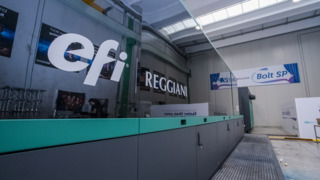
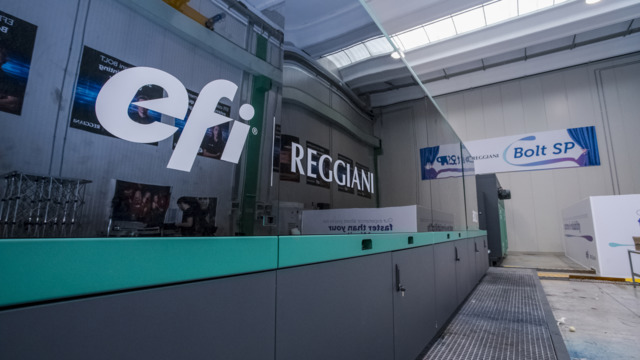 The efi Reggiani (it’s so big, it’s hard to get the whole thing in one image!)Nearly 300 people from 40 countries traveled to Bergamo, Italy, to see the EFI Reggiani BOLT digital textile printer unveiled during a gala event. The company had expected about 100 customers to attend, but with the last-minute demand, arrangements were made to handle nearly three times that many. EFI’s new CEO, Bill Muir, who was celebrating one month on the job, was at the event to welcome attendees. He stated, “The culture of courageous innovation, creating value through products for our customers, is what attracted me to this company.” And innovation abounds with the new BOLT printer, which underwent an astounding one-year development cycle.
Like EFI’s Nozomi digital direct-to-corrugated printer, elements of which are incorporated into this press, BOLT’s development was a company-wide effort, and drew on the expertise of everything from Cretaprint ceramic tile and Nozomi single pass printing to Reggiani’s textile expertise, the company’s software development team in Germany, Silicon Valley, and Pittsburgh Pa., ink development in the UK and Ypsilanti, Mich., and EFI Fiery as the digital front end. The printer is being manufactured in Bergamo.
When the printer was unveiled, there was a shower of confetti and much popping of Proseco corks, as well as gasps from the audience when they first saw it. Some of the details:
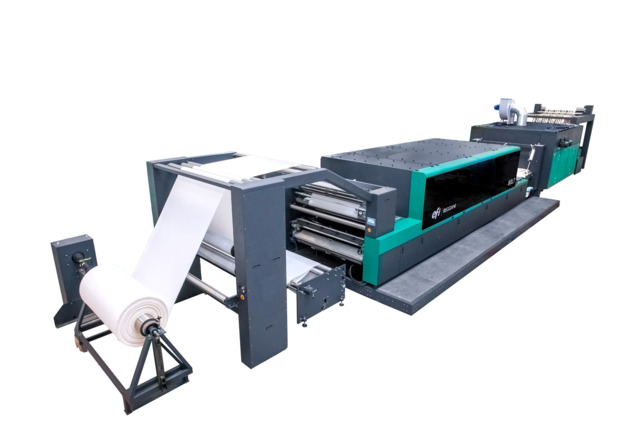
- It’s huge. But with dimensions of approximately 10 meters x 6 meters x 4 meters with eight color stations and two analog stations for adding embellishments like metallics, EFI reports that it is 30% smaller compared to the most compact printer currently on the market. The maximum fabric width is 1,950 mm.
- Its unique printheads were designed in collaboration with Fujifilm Dimatix. It includes a contactless wiping system to extend printhead life. An innovative recirculation printhead concept ensures 3x ink laydown for better print uniformity. The recirculation across nozzles keeps them wet and ready to print, even after a weekend shutdown. Up to 600 x 4800 dpi print resolution.
- Variable drop sizes from 5 to 30 picoliters ensure accurate printing of fine lines through to fast printing of large areas of solid color. The printer can inject more than 15 grams per square meter of ink at the speed of 60 linear meters per minute.
- Real-time print start-up and minimal maintenance needs help ensure the level of uptime a production textile environment demands.
- Depending on the substrate and fabric design, it can print at up to 90 meters per minute. We saw it in action at 60 meters per minute, and then it sped up to an amazing 90 minutes per meter, with exceptional quality.
- It initially will run with water-based, eco-friendly pigment and reactive inks, with further ink types coming soon.
- It has a unique architecture: extractable printing beams that ensure easy access to print heads and the ink system.
- Like all Reggiani digital presses, it features an ink recovery system that reclaims about 95% of ink for re-use.
- Uses Reggiani’s proprietary feeding system for high-performance fabric management, with optional large roll feeder. The precise Kevlar conveyor belt features an embedded magnetic device to ensure smooth, wrinkle-free fabric feeding.
- It can be configured with two to six drying sections, and heating sources can be gas, oil or steam.
 efi Reggiani
In developing BOLT, the Reggiani team visited 20 customers around the world to get feedback on their wish list for single-pass printing. Customers were looking to eliminate barriers to digital, including cost of and life of printheads, cost of ink, and downtime issues. They wanted to get at least as good quality and color gamut as rotary printing. And in bringing BOLT to market, it looks like these objectives have been achieved.
Ron Gilboa of Keypoint Intelligence – Infotrends, and Mark Hanley of I.T. Strategies, both respected consultants in this space, participated in panel discussions during the event. Hanley stated that he believed BOLT to be generation two of single pass, adding, “EFI Reggiani still has to prove that, but chances are high they will be able to do that.” Gilboa pointed out that one of the things that is unique about EFI’s approach is tying in all the supply components, stating, “When you stitch all these things together [design, file prep, printing, business and production workflow, finishing, etc.], you change the way the whole industry is doing business. A new device has value, but when the whole ecosystem comes together, it makes suppliers profitable and better enables the brands we serve at the end of the day.”
Feedback from the attendees I spoke with was overwhelmingly positive. Once samples started passing around, there was quite a buzz, as attendees looked at outstanding print quality on a variety of fabric types.
EFI has had great success with its previous single-pass printers, Cretaprint and Nozomi. It is likely that BOLT will also see early market success. BOLT has the potential of speeding adoption of digital and just-in-time strategies for textiles, as well as helping to reduce the environmental issues found in the textile industry. That’s not to say that conventional printing processes will go away—digital and analog will co-exist for some time, as has been the case in most other segments of the printing industry (ceramic printing, and to some extent sign and display graphics printing, are two exceptions where digital has taken over the lion’s share of production).
In addition to environmental aspects, products like BOLT combined with EFI’s textile ecosystem will help brands create more collections each year, deliver the customization today’s consumers demand, and establish a purchase-activated process for a subset of garment production—replacing the produce-inventory-hope-to-sell model that results in significant supply chain inefficiencies in today’s textile industry.
We’ll be looking for more information from EFI as BOLT is rolled out into the market. Beta sites are in process of being selected, most likely in Europe, and no formal commercial availability has yet been announced. It is likely there will be two beta sites, and as with most product development, these sites will likely drive some change in the product.

