Microban Scentry and Scentry Revive: Innovations in Odor Control for Textiles
Microban recently released Scentry Revive, the second generation of a unique odor control fabric finish that was developed in response to brands seeking a more innovative approach to odor control.
In a recent article, we covered the value and importance of, and new developments in, functional fabric finishes that extend fabric utility. Since then, we learned about another innovative and quite unique set of fabric finishes from Microban that offer a different approach to odor control. We spoke with Brian Aylward, Microban’s Director of Liquid Antimicrobial Research & Development, to learn more—about the company and its latest efforts to bring innovation to odor control in textiles.
WhatTheyThink: Mr. Aylward, let’s start with a little background about Microban and its work in the textiles industry.
Brian Aylward: Microban works with more than 250 brand partners, and our antimicrobial and odor control solutions are featured in more than 1,000 products globally. In textiles, Microban is focused on being the world’s leading provider of these products. In that respect, we offer a wide array of product solutions to our customers around the world. We also see ourselves as a leading innovator of textile functional finishes, as we strive to develop new and improved products to control odor or inhibit the growth of bacteria, mold, etc., on various textile products.
WTT: It sounds like you have two different approaches to this.
BA: Yes. Our textile portfolio is divided into two segments: antimicrobials and odor neutralizers. Our traditional products include antimicrobials that inhibit the odor-causing bacteria on textiles. By blocking bacterial growth, antimicrobials prevent odor from building up on a garment while you are wearing it or while it is in the hamper. In 2014, we began reaching out to our brand partners to ask what they were looking for in terms of new innovations. We got a lot of feedback that customers wanted to see some innovative alternatives to the antimicrobial chemistries that are traditionally used. We set out on a research project to design what ultimately became Scentry, our first odor neutralizing technology, which was launched in 2015 and is in use by a variety of customers.
WTT: How does Scentry work?
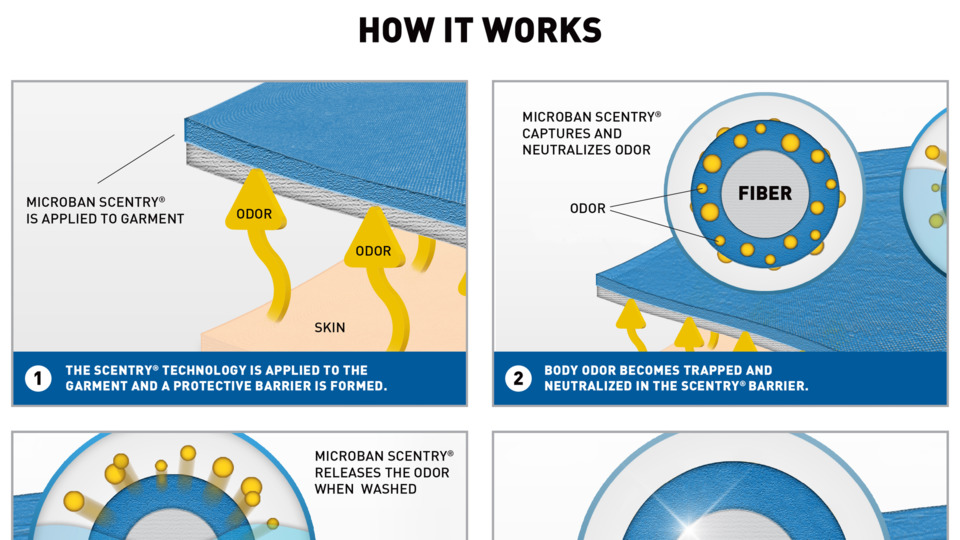
BA: It is an odor capture technology designed to specifically attract and trap the odor molecules that make up the characteristic smell of sweat, preventing the odor from coming back off the textile.
 Microban Scentry
WTT: How is Scentry Revive different, and why would someone choose one over the other?
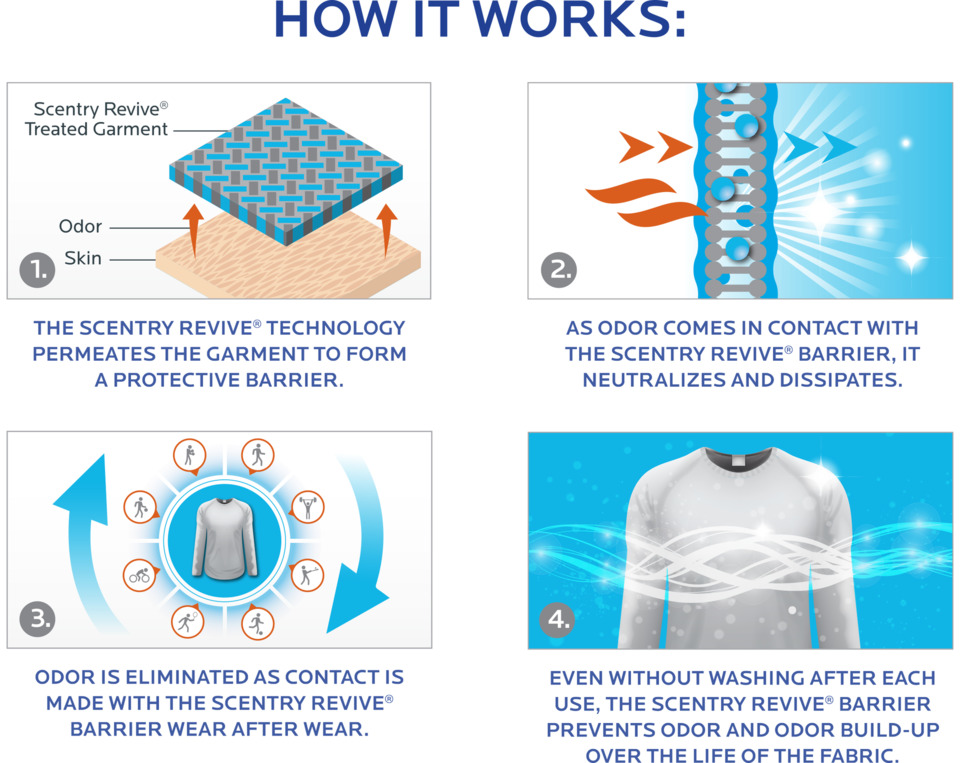
BA: Launched this year, Scentry Revive is our second-generation textile deodorizing technology. Like Scentry it works by capturing and neutralizing odors, but with a greater level of performance. Revive continuously neutralizes odors, and that will allow consumers who have a Scentry Revive-treated garment to re-wear it without odor buildup. Both Sentry and Sentry Revive provide a different means of odor control vs. traditional antimicrobials. Scentry is a nice solution for garments that are going to be washed. This is because Scentry acts like a sponge, which traps and holds odors. Once a Scentry-treated garment is worn, it can go into the wash, and the washing process releases the odor. This recharges the Scentry treatment for the next time the garment is worn. Scentry Revive neutralizes odor more continuously. We see that best used for textile applications where the item may not be washed as frequently, or for footwear that doesn’t get washed at all.
WTT: Do they both last for the traditional specification of 40 to 50 washings?
BA: Yes.
WTT: Was there a specific issue with antimicrobials that brands were trying to avoid?
BA: No. Our partners were looking for something different that could set them apart in the market.
WTT: Are Scentry and Scentry Revive applied at the mill?
BA: Scentry and Scentry Revive can be applied to fabrics during the dyeing and finishing process. We work closely with textile mills to ensure these treatments are optimized. Both products can also be applied to yarns making them great options for socks as well.
WTT: Do Scentry or your antimicrobial treatments have any limitations with regard to print—analog or digital, direct-to-fabric or heat transfer?
BA: We do have customers that are looking to print on these treated fabrics. To ensure that’s possible, we work extensively during product R&D to ensure new products like Scentry have minimal impact on processes the textile will go through after the finish is applied. We also work to ensure new products don’t significantly impact fabric properties like hand feel, wicking, etc.
WTT: There’s a lot of discussion these days about sustainability, or the lack thereof, in the textile industry. Do these products help with that at all?
BA: While our primary thrust is leading the odor control space, a key area that we—and our customers—focus on is the sustainability trend. Customers are concerned about water and energy consumption during the textile manufacturing cycle, landfill issues with discarded textile-based products, and the like. Our goal is to make sure we are designing sustainable solutions that help our customers achieve those objectives as well. The angle that helps our customers market their products is around the water and energy savings from reduced laundering of garments. If we can extend the time between washings, it helps our customers’ customers cut down on their energy and water consumption. Plus, washing is what wears out your garments most quickly. If you can cut down on the amount of washing, you cut down on the rate at which you are disposing of garments. Less washing also reduces the microfibers that are shed into the waterways system.
WTT: A professor and researcher at the North Carolina State University College of Textiles, Dr. A.J. West, told me, “If you don’t have to wash your socks every day, but every other day instead, we can save about four billion gallons of water just on socks alone!”
Are there any limitations on fabric types with these finishes?
BA: We typically design solutions to cover an array of different fabric types. Most of the odor problems are in polyester and poly-Spandex garments in sportswear. We definitely focus on those areas, but we have solutions that can be used with cottons, nylons, linens, etc.
WTT: What might we expect to see from Microban in the future?
BA: Watch this space! We are continuing to innovate, and we have an eye to launching new products to the marketplace. We’ll be happy to share more you as we do!