The Sign Connection: Diversify Your Business to Remain Relevant
Smart business owners in the $26 billion visual graphics industry know that in order to remain profitable they need to remain relevant.
Smart business owners find ways to diversify their business so they are not reliant on a limited number of products or customers, and are able to remain relevant – and maybe even thrive – when uncontrollable factors come into play or when customers demand changes, new technologies appear or new competition enters the marketplace. We’ve all experienced price objections and watched as commodity pricing on banners, corrugated plastic and posters has impacted not only profits but also the public’s perception about what sign companies do. For those in the sheet fed print industry, those lessons are even more significant.
Smart business owners in the $26 billion visual graphics industry know that to remain relevant in our industry, companies need to capitalize on the increasing demand for signage and visual graphics by expanding beyond basic core capabilities. This is even more important to small-format printers looking to diversify their business and generate new, more profitable revenue streams.
What are you selling today? The same products and services that you were selling a year ago? Two years ago? If so, you should be looking to diversify and find new creative ways to help customers get their message out. Let’s take a look at a few products and services that can help you stay relevant: textiles/fabrics, installation, dimensional letters, and digital signage.
Going Beyond Large-Format to Thrive
Printing on fabric opens up new revenue product opportunities. You can achieve vibrant colors, lower shipping costs, less wall weight and more portability by creating visual graphics on fabrics. Think trade show graphics, fine art prints, wall murals and room dividers. Yes, you’ll need good vendors or the ability to purchase a dye-sublimation printer and invest in finishing equipment (such as a sewing machine) .
You may already be providing permits for simple jobs, but what about embarking on larger scale installation jobs?
You can diversify your business by selling custom shaped items and dimensional letters created using cutting and routing equipment.
How about selling digital signage? It is appearing in locations on every corner – from the small bakery to the golf club house to the hospital waiting room.
We need to rethink what our businesses are selling in order to remain relevant in today’s marketplace. Our visual communications industry includes much more than what traditional wide-format has encompassed in the past. As we think about how the concept of large-format signage has expanded to include décor, art, wallpaper, prints, etc., we can reinvent our companies as creative design providers with a vision for fresh ideas that attract more than our current core audience.
Embracing Trends in Time
The time to change is now – before you are forced to change. With increasing competition and more ways to communicate, it may be time to turn in a new direction. While the online channel has solidified itself as more than a trend and is here to stay, many online providers provide only those products and services that are inherently available to the masses. The customer can make a decision on a website rather than interact with a person. The big box stores are expanding what they sell to include banners, posters, brochures and printing, etc. The difference with our companies and online or big box providers is the ability to craft a custom, hands-on approach with our customers. A website can only provide a physical sign, not consult or talk about installation specifics, obtain permits, how a fabric print might be a better option for the need or how a digital sign would add motion and grab attention quicker in an area presenting a challenge.
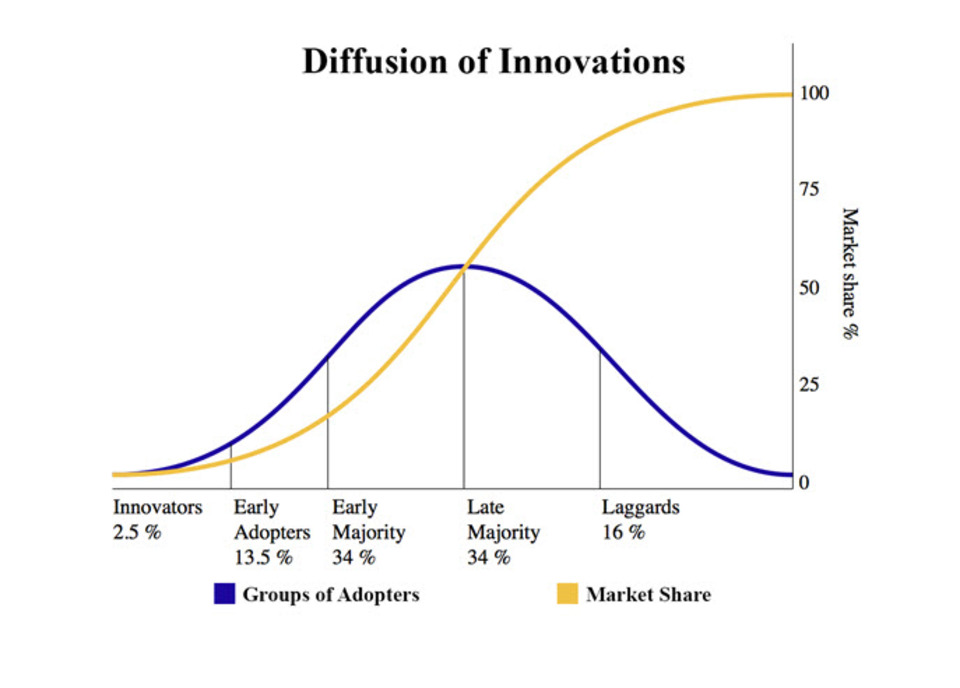
Another way we can look at the impact of readily embracing trends is by learning from a now defunct company that didn’t remain relevant. The “Diffusion of Innovations” is a method to explain how new ideas and new technologies are spread through cultures; diffusion is the process by which an innovation is communicated and adopted over time. On the “Diffusion of Innovation” graphic below, you can see where early adopters get involved in a new technology or product or service. The blue lines are the group of adopters and yellow line is market share. As each threshold is passed, a new group is more likely to adopt. To optimize our success, we need to continue to be on the left side of the adoption curve.
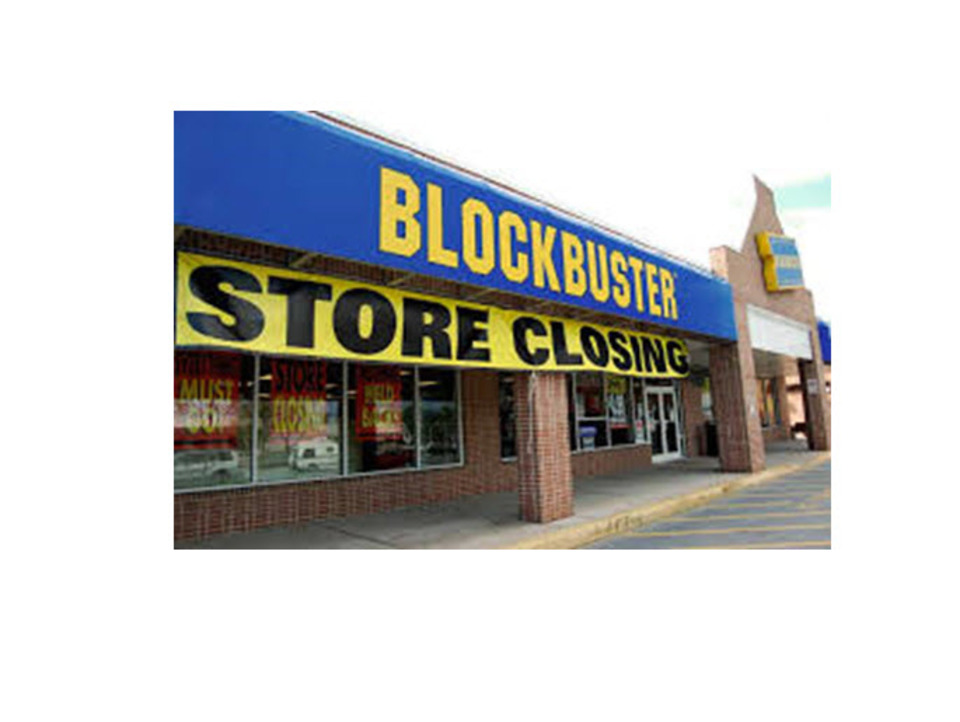
We don’t want our companies to become businesses like Blockbuster®. As the once dominant market leader with 9000 stores, Blockbuster put thousands of independent video rental stores and small chains out of business. In 1997, along came a disruptive innovator, Netflix®, with a new business model that offered subscriptions rather than rentals and made late fees unnecessary. In 2004, at the height of the company’s success, Blockbuster’s CEO realized the need for change, but ran into resistance within the organization. In 2010, after waiting too long to change, Blockbuster filed for bankruptcy. Today, Netflix is worth five times what Blockbuster was at the height of their business. Netflix found a way to be relevant; Blockbuster did not.
Kodak is another example of how being relevant and on top of the market can change quickly. The world revolved around the film photography industry, but the company unraveled in 2003 during the transition from film to digital photography. Kodak’s core business declined and the business declared bankruptcy in 2012. The re-structured business now provides digital services to other businesses.
Evaluating Your Resources
As companies invest in new technologies and equipment to remain on the cutting-edge, we also need to invest in our staff and evaluate our human resources. A change in technology can increase your output and productivity, but it can also result in the need to bring in new people to meet the needs of expanding capabilities. When we blend new employees with existing staff, our teams are building a better work environment with more skills, resources and experience than ever before.
We need to ensure that both incoming employees and existing teams are receiving proper training to help them stay relevant. By hiring the best new employees possible, we will have the diverse skill sets, training and experience to help grow the business. Employees are often our brand ambassadors and can help you keep the pulse on the industry by monitoring the latest trends and becoming informed about opportunities and using creative thinking to increase business.
Adopting New Directions for the Future
As we build and sustain our companies, we can implement strategic plans for ensuring the ongoing relevance of our business in the visual communications industry. We can become flexible and thrive beyond our core business. We can recreate our existing companies by offering expanded products and services.
As business owners, we must find ways to stay relevant and grow our businesses.