Both Sides Now
Ensuring even pressure between nit rollers is just one of many lamination advancements.
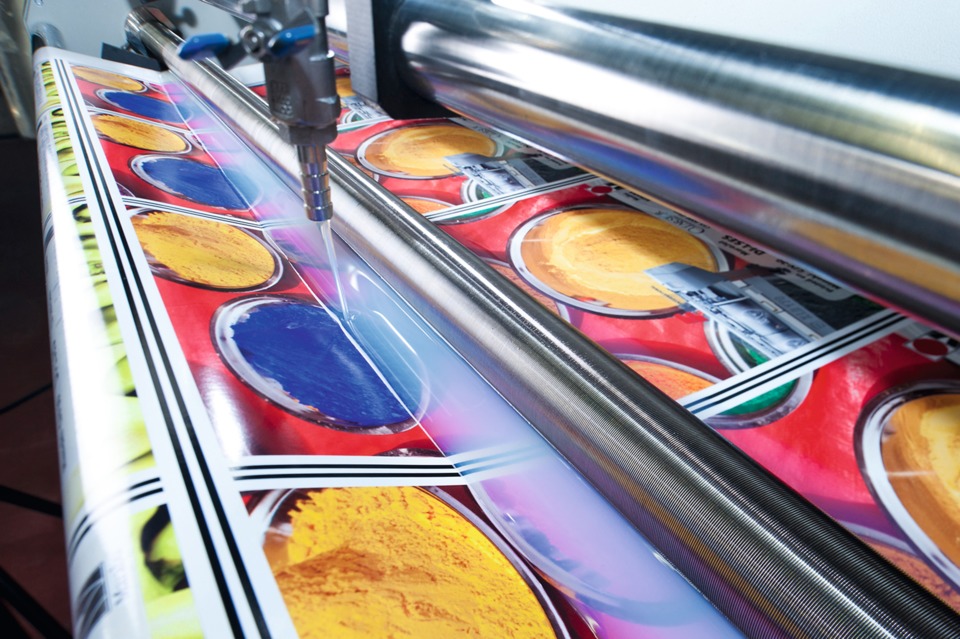
Laminators are playing an ever more important role in printing. Lamination is used to protect and/or add visual enhancement to a wide range of printed materials, from signs, banners, trade show materials, canvas and vehicle graphics, to name just a few.
As the importance and uses of lamination grow, so do the tools to laminate printed materials. Technological advancements have made possible steady improvement in the ease of use, speed, and quality of laminators and laminates. With the number and complexity of available choices proliferating, it’s incumbent on Print Service Providers (PSPs) to really do their homework before making an investment in lamination systems. This month, experts advise on how to do just that.
Product evolution
One of the most significant developments in the steady advancement of lamination equipment technology results from the fact most laminates are now pressure sensitive. So says Frank Corey Sr., accounting manager with Quality Media & Laminating Solutions, a distributor of laminates, laminators, and print media. “Most have a release liner,” Corey added. “One of the innovations is that the more advanced laminators like ours either have a pneumatic take-up that uses a dial, or a synchronized system that ensures the laminate and take-up shaft are at the same speed.”
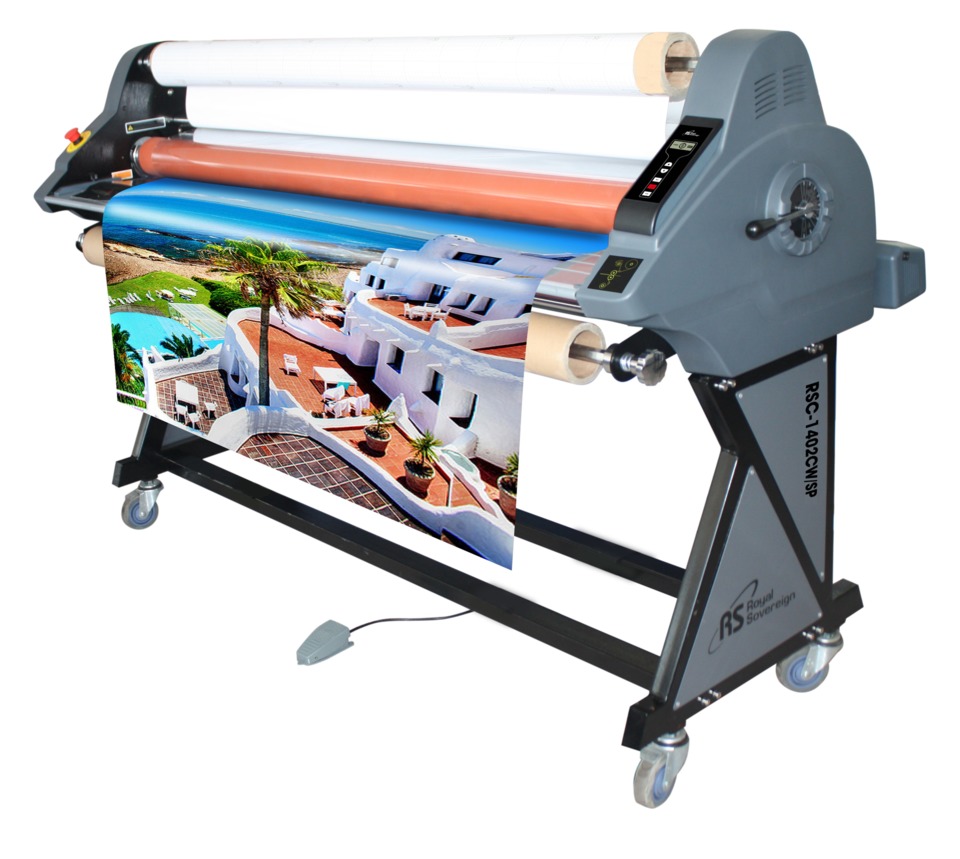
Daniel Kane, marketing manager, graphics with Royal Sovereign, views controlled pressure as a key advancement. “Wide-format laminators are experiencing the rise in measurable and controlled pressurized rollers,” he said. “[They are] either mechanical or pneumatic-driven, like the Paramount 65X from Royal Sovereign. Measurable and repeatable pressure is essential in traffic graphic application when a specific PSI is required.”
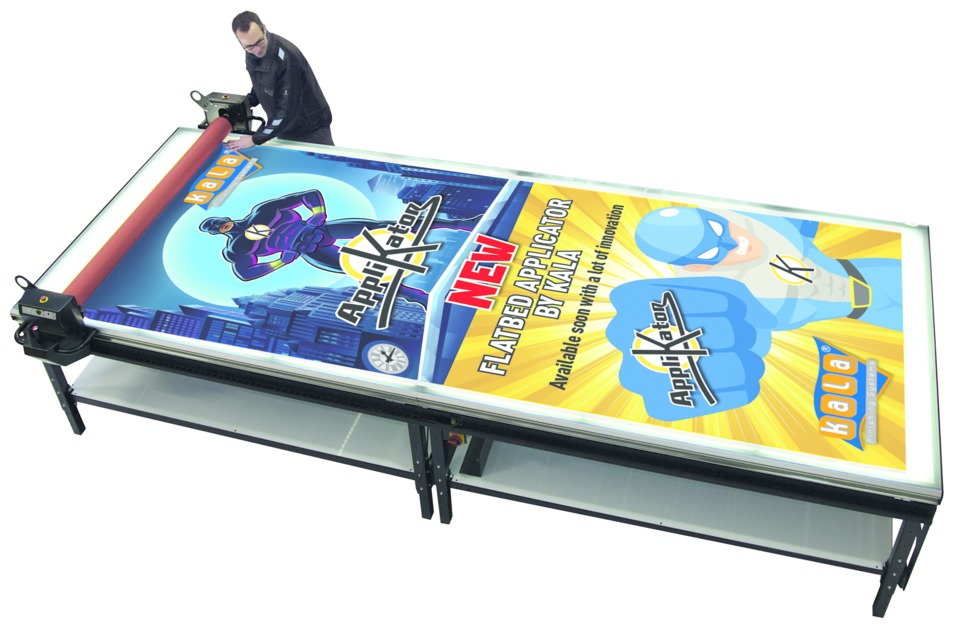
Maintaining even pressure is critical for top results in lamination, notes Frank Romanello, president and CEO of Rolinx Performance Products, a distributor of Kala Finishing Systems, a French-maker of roller laminators, applicator tables, and XY cutters. “Applications today—for example, vehicle wraps—can consist of very long runs,” he said. “They protect the inks by applying a lamination film to the surface. Our laminator allows the operator to run this product through without any waste from roll to roll, without any supervision and without skewing left or right due to uneven pressure.”
Another important step forward is in the sturdiness of the laminator chassis, he added.“There’s a need for a very solid, sturdy frame, because if the frame is compromised there could be uneven pressure at the nip, where the rollers converge, resulting in skewing,” he reported. “We’ve responded by making a one-piece welded steel frame which allows our rollers to maintain a very tight tolerance.”
Lamination is often referred to as either an art or a science, he continued. “Getting consistent results has been a very difficult task. But since Kala came out with its auto calibration, they've turned it into a profitable process where people don't need to be intimidated.”
At Marabu North America, marketing manager Sarah Stafford reports her company markets two different types of liquid laminates, one a water-based liquid laminate and the other a UV-curable liquid coater. It also makes available its StarLam roll-to-roll liquid laminator for wall coverings, canvas, and other flexible substrates.
“The big thing that's changed is the UV coaters,” Stafford said. “They have become more affordable for [PSPs] for a variety of reasons. The speed and greater affordability means they're becoming a more viable option. We don't manufacture a coater ourselves, but do partner with others that provide coaters from 14 to 63 inches. There's a broad spectrum of coaters available, depending on what you're looking for.”
Weighing options
When PSPs weigh different lamination options, they should closely examine how pressure is adjusted between the nit rollers through which the laminate moves, Corey said.
The reason pressure must be measured is that mounting to different substrates requires different levels of pressure. Mounting to foam core requires less pressure than mounting to Sintra, for instance. “There are a few different ways that the nit is adjusted,” Corey added. “In very basic machines, nobs at each side allow the pressure to be adjusted. Or you could have a single crank that adjusts the nit. Alternatively, there could be a pneumatic or air system control. The final option is that the adjustment is done through a motorized control.”
In the lowest cost, most basic type of machine, adjusting both sides equally is very difficult. With single crank systems, operators have to be guided by a dial or a series of lights, Corey noted. By contrast, operators can make adjustments as needed with pneumatic and motorized nit systems. “We offer crank, pneumatic, and motorized systems,” Corey said.
It’s also important that PSPs choose the proper grade of high-tensile steel in the laminator’s rollers, and a proper coating process of the rubber surfaces in the laminator’s rollers, Romanello said. Doing so helps ensure the crucially important pressure equilibrium. “Your rollers are the heart of your machine,” he explained. “It’s important to use a very high tensile steel in the rollers to prevent any structural deficiencies, and prevent the rollers from sagging. And of course, it’s also important to have the correct rubber coating on the rollers to ensure even pressure from edge to edge.”
In addition, PSPs should keep in mind that when purchasing equipment, it's important to consider both current and future, more profitable, applications, Kane said. “Most equipment does not have the option for aftermarket upgrades, such as adding heat assist to the top roller, or adding accessories for roll-to-roll lamination,” he noted.
For her part, Stafford emphasizes the need to consider the type of substrate you will be laminating. “Am I looking to coat a flexible material that's going to be rolled?” she asked. “Or will I be coating a rigid substrate? They're not going to use the same machine. The StarLam is a great option for flexible substrates like canvas. But if you're looking at a rigid substrate, you're going to go more with the UV line.” In addition, she advised PSPs, “purchase the largest, most capable equipment that will cover your needs, enabling the benefits they offer to be provided to your customers.”
Making more money
It's easy to grow profits simply by choosing liquid laminates for jobs requiring lamination, Stafford maintained. “In the past, a lot of people have used film lamination, which gives you abrasion, UV, and chemical resistance, along with other benefits,” she said. “But you're going to get all those benefits along with cost savings when you use the liquid. You don't have to worry about trimming, or the alignment. Your production manager sets it up and can walk away. The StarLam does not require constant attention. You're looking at a more efficient, and effective piece of equipment—and technology. It's a quicker ROI; paying off the StarLam can take as little as 13 months.”
The ongoing evolution of lamination technology is creating new ways for PSPs to grow sales and profits, said Kane, Corey, and Romanello. For instance, Kane says, PSPs can expand beyond lamination to include pre-masking, mounting, and vehicle wraps. Another way to increase profits is to heighten the value of digital prints by adding a laminate finish, such as luster, matte-sand, or gloss, he said.
Corey could not agree more on the suggestion of providing greater variety and value. “The most successful shops have either a display or sample book, take a print and display the same image with a pressure-sensitive laminate, a gloss laminate, a luster laminate, a matte laminate, and a textured laminate,” he said.
“They can say, 'This is what we can do to protect your print.' I have found the most successful people place these images on the wall and ask [customers] just which surface they want."
PSPs also need to explain the difference between the characteristics of cast and calendared laminate, Corey said. Calendared is a less expensive option that typically lasts two or three years outdoors, and over time experiences shrinkage on the edges. Moreover, this option works only on flat surfaces. “Cast vinyl, which is 2 mil. thick, is good for a minimum of seven years outdoors,” Corey said. “It will not shrink and can go around any bend with no issues."
Often, the intended end use of the image will determine what laminate is utilized. If producing images intended for applications that might draw fingerprints, a sand-textured laminate can be the solution that produces greater customer satisfaction and repeat orders.
“If you're doing displays in areas that have very specific lighting that can affect viewing of the prints, you'd use a laminate with a matte surface that would cut down on some of the reflection,” Romanello said. “You can use thermal laminates to add rigidity, as well.”
As for the future of laminating systems, PSPs can look forward to the advent of a new breed of very specialized machines, Romanello predicts. “It's great to have a laminator that can do everything. But in the future we may be looking at the introduction of equipment designed to very specifically take on given applications,” he said. “That will not only be more efficient, but more cost-effective, as well.”