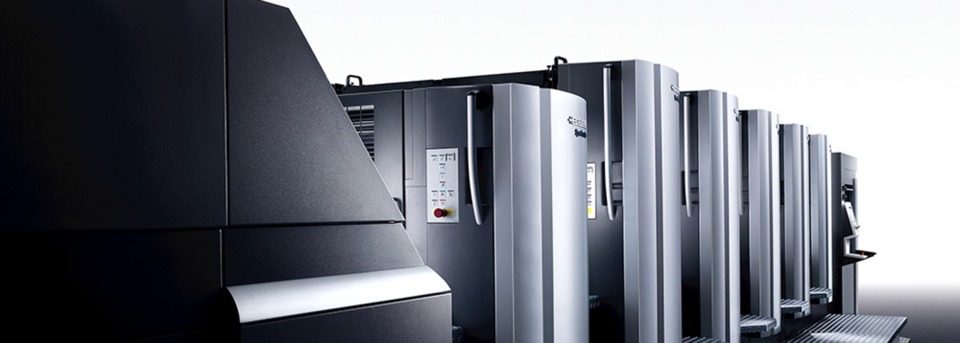
Automation Drives Offset Efficiency, Productivity to New Heights
Press automation lets print service providers compete effectively against digital presses for short-run multi-color work.

Press automation, critical to the modern offset facility, lets print service providers compete effectively against digital presses for short-run multi-color work, while satisfying print buyers demand for faster turnaround, just-in-time production, greater color bandwidth, and shorter run lengths.
While automation isn’t new – automated plate changing dates back to the early 1990s – new types of automation continue to come down the pike. Automation technology is designed to eliminate or at least slash setup for factors that are unnecessarily time-consuming. Automatic plate changing, at least in its basic form, is nearly standard on most modern offset presses. But that’s just the tip of iceberg, with a host of production variables now available in automatic control mode, whether it’s adjusting water, ink-key and fountain solution settings or controlling color and density.
The many varied options provide PSPs with the ability to customize their presses, picking and choosing which automation features make sense for their operation.
Imagine! Print Solutions, headquartered in Minneapolis, MN, found that one new KBA Rapida 105 press easily replaced two of its existing presses, adding 50% more productivity and delivering better quality, for less money and faster speeds. The press is configured with seven colors plus coater and KBA VariDry UV system as well as a KBA inline color control system.
Ryan Printing’s (Blauvelt, NY) 5-color Speedmaster CX 102 with Prinect Inpress Control’s inline closed-loop color management system drives down make-ready times to less than 10 minutes, and enables the CX 102 to come up to precise, LAB matching color while cutting hundreds of waste sheets with each makeready.
Industry giant Labelmakers Group Pty Ltd in Australasia, which serves various markets, especially the fast moving consumer goods (FMCG) market, invested in an eight-color ROLAND 700 Evolution from manroland, with coating module equipped with InlineColorPilot and InlineInspector.
The InlineColorPilot is manufactured to automatically detect and correct inline even the slightest color variation. With the application of both InlineRegister and InlineColorPilot, precise color register and color management can be simultaneously accomplished.
In Minnetonka, MN, Wallace Carlson’s new Komori GL840 is equipped with full-APC (fully automatic plate changing system) that operates by sequential control to enable the fastest plate changing and Komori’s dual-camera PQA-S system (in-line print quality inspection system for sheetfed presses) that detects printing defects, particularly important for companies like Wallace Carlson that produce high-end applications.
The increased automation available on sheetfed presses also changes the offset vs. digital tipping point. The tipping point is relative to how much automation a customer wants to use, noted Doug Schardt, National Product Manager, Komori America Corporation. “If you ran all the automation available, digital doesn't come close,” he said. “By the time a digital press has warmed up, we have produced two-three jobs.
In terms of cost and speed, digital presses wouldn’t even come close to beating a new offset with automated technology, added Schardt.
Looking at its automation technology, “the approach now from Komori, is not just about opening up productivity, but it’s also about efficiency, which has to do with costs,” said Schardt.
Komori's KHS-AI software achieves ink and register stability in just 20 sheets-dramatically reducing make-ready time and paper waste, he added.
The Asynchronous Automatic Plate Changing Systems (A-AOC) feature changes plates in 75 seconds. The Inline Print Quality Assessment System for sheetfed (PQA-S) not only inspects print quality on the front and back sides of the sheets simultaneously, using a high-precision CCD camera and lens, but also enables in-line density control by scanning the color bar. In addition to checking for color irregularities, the system is designed to check for smears, ink splashes, water drops, oil spots and hickeys. When identified, sheets with imperfections will not continue through the printing process, eliminating the risk of unacceptable sheets being mixed with good sheets.
These system features, in concert with KHS-AL-Linked Smart Feedback technology, help shorten the time needed for color matching and reduce plastic/ paper waste at print start-up.
Presses can also be equipped with a PDC-SX scanner that uses spectrophotometry, an instrument that not only measures ink key density but also automates color control; the press can run to target color, not just density. An automatic register function allows a simultaneous measurement of both colors and register.
Komori is also addressing the time between jobs with Smart Sequence, a way of linking jobs for automatic production runs, says Schardt. Operators can book up to 10 jobs ahead, and put those in logical run order electronically and also assign job-by-job the most appropriate of three pre-programmable automatic operations for complete press set up. These include de-inking, wash ups, pre-inking, plate changing and full automatic make-ready.
The press immediately moves into washup and prep steps as soon as the previous job hits the page count.
With our new technology, we even address lubrication, solvent use, power, and maintenance; all the things that cost money and take time,” said Schardt. “We offer automated color washes for printers who run a lot of PMS. PDF Compatriot scans the entire sheet and compares to PDF file to make sure all is correct.”
For life after make-ready there is the aforementioned Smart Feedback, which lets the operator temporarily recalibrate the ink profile on any or all units at a single keystroke.
“It re-establishes the density, whether it’s a prior density number or new one, in only 40-50 sheets,” said Schardt.
Also, Komori’s H-UV Curing System makes is possible to go from the press directly to bindery.
“Most [presses] offer automated ink-keys; what we offer goes way beyond ink key control,” said Schardt. “We have to face the fact that in years to come, skilled labor will be scarce. We are preparing for a time when PSPs have to change the way presses are staffed.”
KBA’s approach is to integrate, wherever possible, otherwise sequential make-ready steps into a simultaneous and essentially automated job changeover process.
KBA is dominate in sheetfed automation, allowing the customer to pick features that drastically reduce make-ready times, said Walter Chmura, KBA vice president. “KBA’s sales manager’s work closely with customers to determine which automation features will have the largest financial impact to their bottom line,” he added.
Its research and development team is customer focused on reducing make-ready times to zero, explained Chmura. Make-ready times are reduced by having make-ready features work simultaneously using the ErgoTronic console with the new TouchTronic operating system, equipped with one button job changeover.
The KBA Job changeover program allows operators to specify all settings for the coming jobs, and optimize the order of the planned jobs. Data on the ink coverage is displayed for each job, enabling the jobs to be sorted in accordance with their individual color assignments based on ink film thickness, for example the operator can select the rotation of the jobs starting with light ink coverage to heavy ink coverage. “In this way, both washing times and start-up waste can be kept to a minimum,” explained Chmura.
The Rapida press today is able to wash the blanket cylinders, impression cylinders, and change all of the lithographic printing plates simultaneously using Plate Ident plate identification system to register the printing units before the first press pull is made. Plate Ident uses sensors on the plate holder to detect additional register marks; register presetting values are calculated individually for all printing units. Reading of a data matrix code verifies the presence of the correct plate for the current job.
This ErgoTronic driven make- ready drastically reduces make ready times, said Chmura. (See attached slide titled DriveTronic SPC – Simultaneous Plate Change).
Also new is the function “FastInkUp.” The effect is realized in two steps. First, the operator can deactivate the ink vibrator up to 20 sheets before the end of a job. This serves to reduce the volume of ink in the inking unit, albeit without any reduction in density becoming visible on the sheet. After the plate change, ink run-up for the new job starts automatically with the building of the new ink profile by engaging the duct roller with one cycle.
KBA LogoTronic provides for company-wide digital data exchange between management, production, purchasing, logistics, and general office departments. It offers tailored open data transfer solutions to suit print enterprises of all sizes, whatever their business strategy. LogoTronic Professional is designed especially for larger enterprises with more than one press, and that also have other Opera components (ErgoTronic, QualiTronic etc.). It ensures that digital data must only be entered once to become available in all departments of the company. Additional modules such as PressWatch and SpeedWatch also permit live evaluation and analysis of the current production.
“A LogoTronic network can be tailored precisely to the needs of the individual user, with the flexibility to grow step by step as the business expands its implementations of fully digital data flows,” noted Chmura.
ErgoTronic ColorControl automatic color measuring system scans control strips at any position on the printed sheet. “Once the control strip is scanned, the measured solid densities are graphically displayed on the screen,” Chmura explained. “The measurements can then be confirmed as a basis for single or dynamic corrections of the ink key settings. Corrections can be accepted and transmitted to the press for automatic modification of the ink profile. KBA also offers a scanning Spectro densitometer that is integrated on the operator console.”
The QualiTronic ColorControl inline color measuring system is integrated directly into the press together with an LED illumination to permit fully automatic measurements in control strips. The measurements are used as a basis for fast, dynamic inline color correction. It is furthermore possible to create inline measurement reports in PDF format. After the measuring system is set up, all measuring patches are scanned on every printed sheet, right up to maximum production speed. The first setting corrections are realized immediately after the job start; once in production, a control cycle of 10 sheets is effective.
KBA also offers QualiTronic/ErgoTronic INSTRUMENT FLIGHT as the top solution, based on the multidimensional System Brunner color/gray balance control strategy. System Brunner takes into account more than 30 print-influencing variables in every ink slide zone. Five different Balance Control Priorities can be selected. It also ensures flexibility and compliance with international standards and methods like Globalstandard, ISO/PSO, G7, etc. The heart of the application is innovative and sophisticated software that is the result of more than thirty years of practical experience with printing process control.
KBA also offers the software option “Fast plate change," enabling the changing time on presses with fully automatic plate changing to be reduced by 50% to approx. 3.5 minutes. Simultaneous Plate Change takes place on all printing units. The printing unit’s plates can remove and reinstall plates in 50 seconds. Parallel washing can take place while changing plates using the computer driven make-ready from the operator console. Plate change parallel to other make-ready processes on the press, e.g. blanket washing; slashing effective make-ready time to 0 seconds, said Chmura.