Solving the Mystery of Industrial Printing
We can identify five primary segments in today’s printing industry: commercial, sign and display (aka “wide format”), textiles, packaging and industrial.
As we all know, the lines between these segments are blurring; heck, entire trade events have been based on this very premise. We all have a pretty clear idea what four out of five of these areas consist of, but the last one—industrial—tends to be the murkiest.
We can define industrial printing as “printing that is done as part of a manufacturing process.” Unlike commercial printing, where the print itself is the end product, in industrial applications, the printing adds decoration, information and/or branding to a functional object that is itself the end product. Think of brand names on auto parts, the text and symbols on a dashboard, the gradations on a medical syringe, the numbers and other button indicators on a TV remote—you name it.
Certain types of industrial printing are also called “functional printing,” referring to printing that has a “function” other than being print or print-based communication.
According to market research firm Smithers in its report "The Future of Functional and Industrial Printing to 2024":
"Industrial and functional printing covers the use of high-productivity printing processes (with the associated finishing) as part of the production of manufactured items that are not mainstream graphics, publishing or packaging where print is the key component. Print may be decorative, as in clothing, a promotional giveaway or wallpaper; alternatively it may provide functional properties as in the case of a sensor or a display."
Smithers identifies nine distinct segments in industrial/functional printing: décor and laminate, glass, promotional/miscellaneous items (aka specialty printing), ceramics, aerospace and automotive, inkjet textiles, electronics, life sciences/biomedical and 3D additive manufacturing.
"In 2019 all functional and industrial print is valued at $97.7 billion, the equivalent of 69.3 billion m2 printed," according to Smithers. "The market is growing strongly, up by an average of 11.9% CAGR from 2014 with print volume (excluding 3D) rising at an average 6.2%, and while these rates moderate from 2019 and 2024 to 7.0% CAGR in value and 4.9% by volume on average, the market will grow to a total of $136.8 billion in real terms."
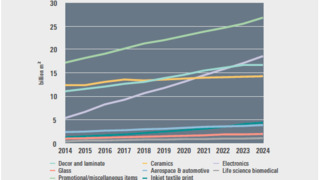
Figure 1 breaks out the forecast by eight of their nine segments (sans 3D).
 Figure 1: Global functional industrial print market by application 2014–24 (billion m2) (Source: Smithers)
Segments such as aerospace, automotive and biomedical are more likely to be printed in the traditional sense—as part of a manufacturing process—while other segments, such as promotional/miscellaneous items, printed décor and textiles lend themselves to an approach akin to commercial printing—and therein lie the opportunities for commercial shops.
Selected Industrial Printing Applications
In the WhatTheyThink Fall 2019 business outlook survey and "Printing Outlook 2020" report, we took a close look at certain aspects of industrial printing—in particular, those that represent the best opportunities for commercial shops. This is not to say that aerospace and automotive print applications are out of the question, but your average shop is not going to start printing custom dashboards for BMW, as cool as that might be. So I’ve narrowed down our look at industrial printing to some of the most relevant segments for commercial shops.
Textiles
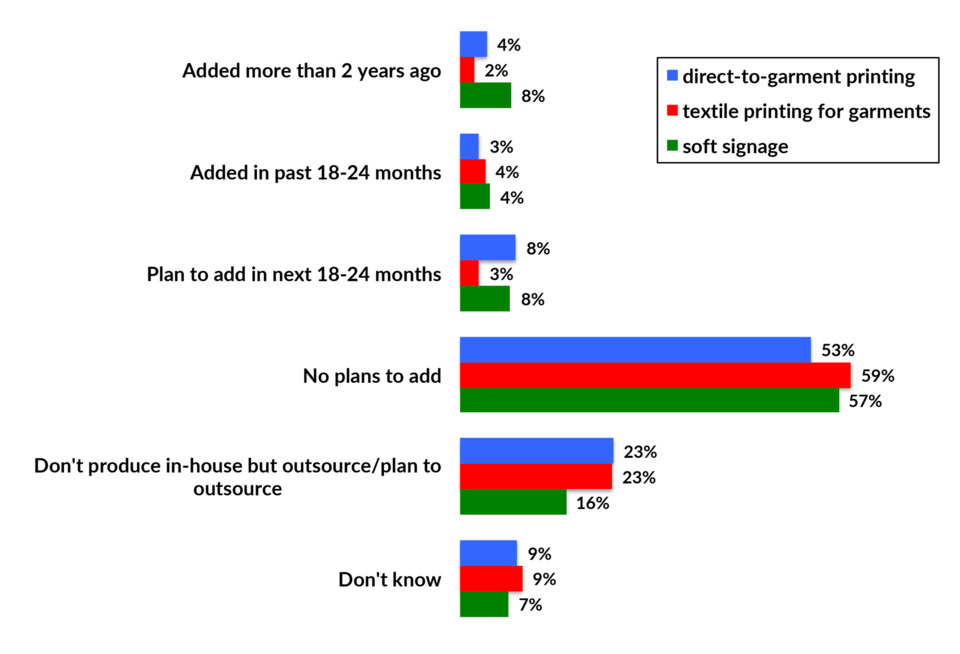
As a subset of industrial printing, textiles are hot, but our survey data has found that excitement for textile applications is lukewarm at best (see Figure 2).
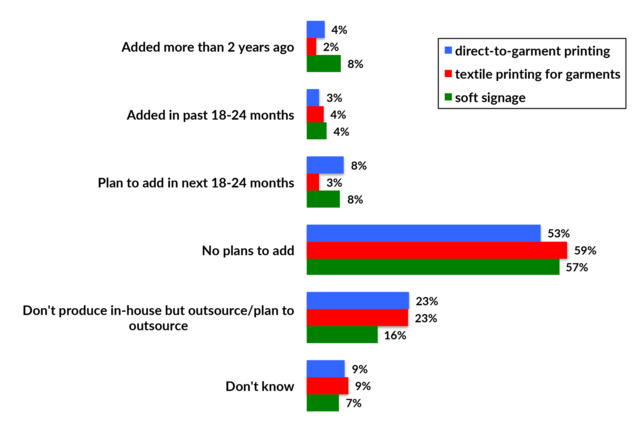 Figure 2: Have you added, or do you plan to add, textile printing capabilities? —Commercial printers, Fall 2019 (Source: WhatTheyThink Printing Outlook 2020)
CAPTION: Figure 2: Have you added, or do you plan to add, textile printing capabilities? —Commercial printers, Fall 2019 (Source: "WhatTheyThink Printing Outlook 2020")
Textile printing is not for everyone, although soft signage is not much different from other kinds of signage. Garment printing is probably even less for everyone, although direct-to-garment (DTG) printing—which is different than garment printing/decorating—has the lowest barrier to entry, as it involves printing onto pre-made apparel, such as T-shirts, shorts, caps, etc., rather than on raw fabric which then needs to be sewn into a final product.
Specialty Printing
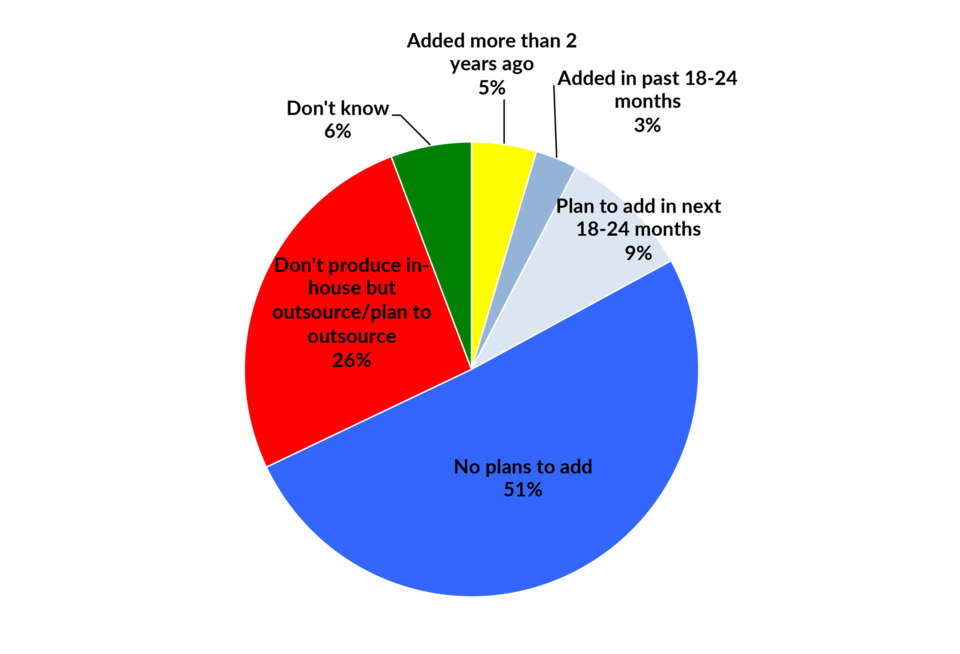
Specialty printing involves printing on objects like coffee mugs, golf balls, smartphone cases, etc. UV inkjet devices from the likes of Mimaki, Roland and LogoJet have made this kind of printing just about as easy as DTG printing, and these are in-demand items used for marketing and promotion. For commercial printers, though, it remains more of an outsource product area (see Figure 3)—although a lot of inplants, especially in higher education, have been getting into this kind of work.
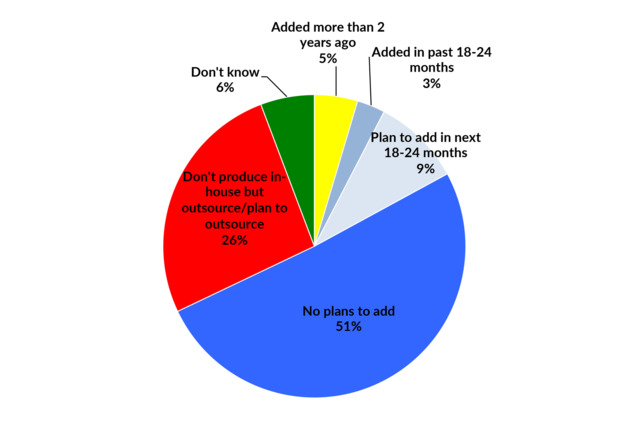 Figure 3: Have you added, or do you plan to add, specialty/promotional printing capabilities? —Commercial printers, Fall 2019 (Source: WhatTheyThink Printing Outlook 2020)
CAPTION: Figure 3: Have you added, or do you plan to add, specialty/promotional printing capabilities? —Commercial printers, Fall 2019 (Source: "WhatTheyThink Printing Outlook 2020")
3D Printing
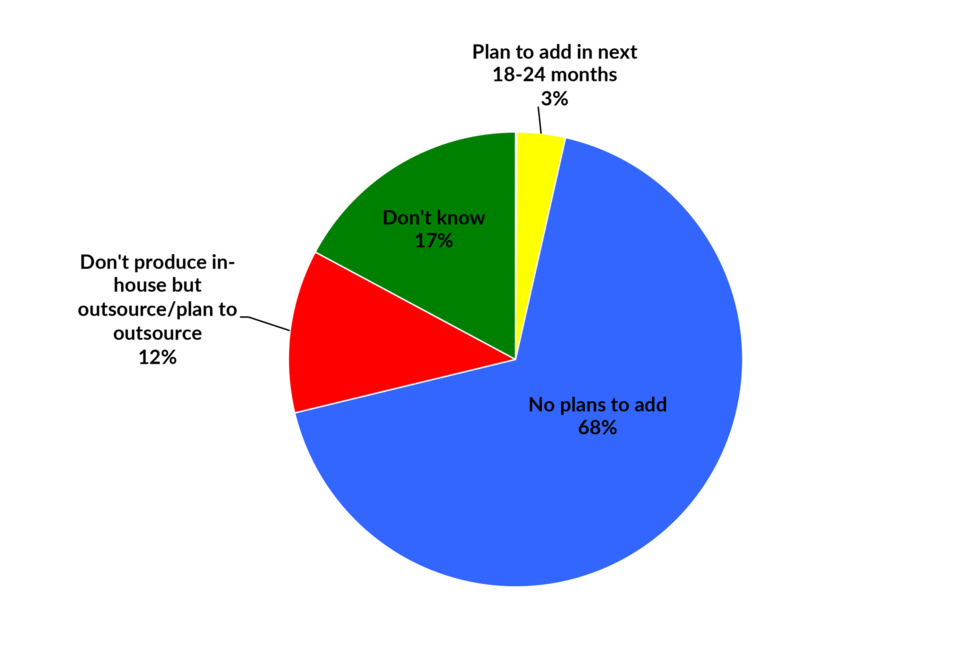
Another aspect of industrial printing relevant to the commercial printing market is 3D printing. In our fall survey, we didn’t see a lot of interest in it (see Figure 4), but there are substantial opportunities for general commercial printers in 3D printing, especially in retail, to complement 2D wide-format display and décor graphics. Mimaki’s new 3D printers have also been adopted by the gaming and hobbyist industries to create game tokens and other unique items (see “Mimaki’s Virtual Unveiling” in our June/July issue). During the COVID-19 crisis, some print businesses got immersed in 3D printing while manufacturing face shields and other PPE, which may have shown them that it’s not difficult to master.
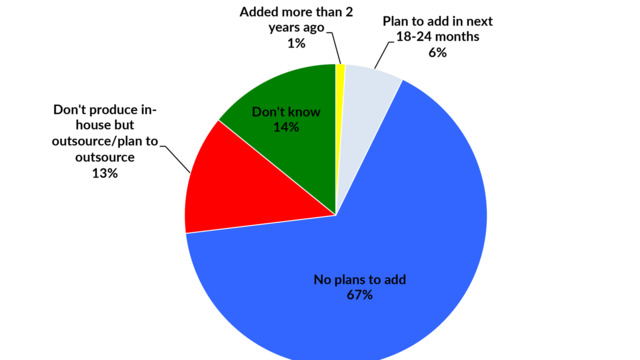 Figure 4: Have you added, or do you plan to add, 3D printing capabilities? —Commercial printers, Fall 2019 (Source: WhatTheyThink Printing Outlook 2020)
CAPTION: Figure 4: Have you added, or do you plan to add, 3D printing capabilities? —Commercial printers, Fall 2019 (Source: "WhatTheyThink Printing Outlook 2020")
Printed Electronics
It’s not the best opportunity, but printed electronics—circuit boards, membrane switches, etc.—comprises high-value products, even if they can be tough to get into. Not too many commercial printers have seen printed electronics as a hot application area (see Figure 5).
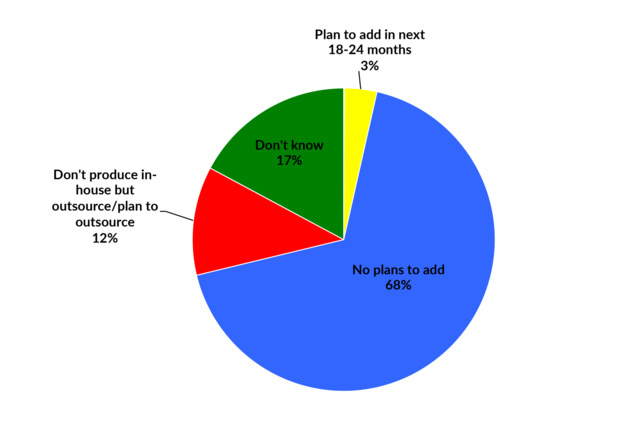 Figure 5: Have you added, or do you plan to add, printed electronics capabilities? —Commercial printers, Fall 2019 (Source: WhatTheyThink Printing Outlook 2020)
CAPTION: Figure 5: Have you added, or do you plan to add, printed electronics capabilities? —Commercial printers, Fall 2019 (Source: "WhatTheyThink Printing Outlook 2020")
Printed electronics can require a degree of engineering and technical skill far beyond ink on paper, but some printing companies have managed to successfully branch into it, usually by creating a separate business as a greenfield project. For everyday printers, it requires more time and engineering expertise than they may have or want to dedicate. (NFC chips like those being used for SpeedPro’s InfoLnkX—see page 18—are kind of a gray area, but are not typically what we mean by “printed electronics.”)
Looking Forward
Industrial printing has come to include many different kinds of products and printing technologies. It’s almost like the term “wide-format printing” which also encompasses disparate applications and, like “industrial printing,” is a term virtually unknown to anyone who buys print. At the end of the day, though, the key is to focus on the specific kinds of products you want to print, and are in demand (or are in potential demand) from customers.