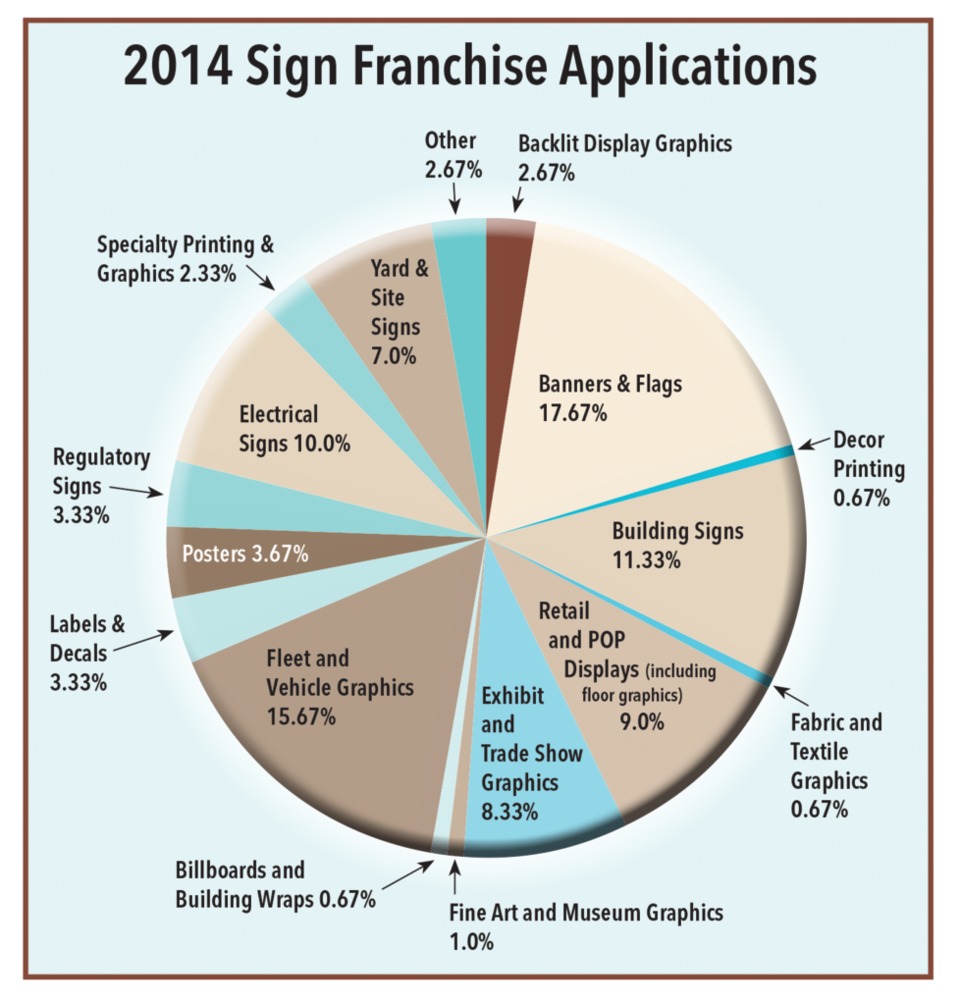
2014 Sign Franchise Review
Despite industry consolidation, sign franchisees are growing profits, increasing sales, and finding much success
Despite the economic downturn and the uncertainty in the economy, the wide-format sector of the graphics arts market has seen growth over the last few years. This, in turn, has caught the eye of related print businesses—from commercial to screen printers—looking to increase their own profits and diversify their business. Throughout the US and the world, sign franchisees have seen increased competition in the marketplace because of this. But year after year, sign franchises are seeing growth—in some cases record growth—and an increase in new market development.
“2013 was a record year for FASTSIGNS in every metric; we surpassed 2012, which had been the record year for the company,” said Catherine Monson, CEO, FASTSIGNS. “We set records in average unit volume, number of locations, system sales, number of outside sales people, net promoter score, franchisee satisfaction, franchise sales and we signed franchise agreements for five additional countries which will open in 2014. 2014 is off to a very strong start in same center sales up just under 10 percent YTD.”
“I feel that the industry as a whole is exhibiting strong growth across the board. We are seeing a lot of new market development that is enabling sign business owners to branch out from their normal service offerings to close more sales,” affirmed Ray Palmer, president of the Sign & Graphics Division for Alliance Franchise Brands (which includes Signs By Tomorrow, Signs Now, and Image360). “2014 was a strong year. We have experienced growth in all sectors of our business, while successfully maintaining three strong brands. We can also measure our success by the amount of activity we are seeing on the development end of the business. We are receiving an increased amount of interest from prospective franchisees interesting in operating under the Alliance Franchise Brands umbrella. It is a very exciting time for our company!”
“The franchise segment of the industry is very strong. With our rebranding efforts this year, franchisees are reaching new market segments that are focused on renewing their brands and want a premium brand like ours to help them with growing their business in the future,” said Paul Granaroli, vice president, operations & training, Signarama. “Our stores sales and profitability are up all across the brand. With our focus as a brand on vertical markets and profitability, our franchisees will be reaping the benefits from these areas.”
The Numbers
The numbers from the franchises are bearing out the comments from franchise executives. This year was the first year Signarama agreed to participate in this industry review, so in order to provide an accurate year-to-year comparison, it was necessary to back out those numbers in this review in several key metrics. This year’s review includes data from four franchise groups: FASTSIGNS, Signarama (including Signarama and Speedy Signs), SignBiz Inc. (including SignBiz and LobbyPOP), and Alliance Franchise Brands, Sign & Graphics Division (including Signs Now, Signs By Tomorrow, and Image360).
For 2013, the sign franchises had total sales (system-wide) of $929,686,684. Once we back out Signarama’s figures, we see a positive 4.47 percent growth in year-over-year total sales from 2012 to 2013. Total system-wide sales for North America were $751,320,848, but once adjusted only up 1.14 percent over 2012 numbers. Sales-per-shop in 2013 were also up just 5.61 percent over 2012 numbers, with franchisees on average pulling in $554,418.25 in sales in 2013.
The total number of shops in the market were up slightly—1.1 percent or 20 businesses—from 2012, topping out at 1,798. Of those, only one location is co-owned and 1,116 are located in North America.
Technology Enables Growth
While we’re not seeing double-digit growth overall, the positive track of these figures indicates a healthy and strong market. Franchise executives pointed to a number of technological developments that have helped to enable growth in their franchise and the market. Flatbed printers and cutters as well as the integration of interactive media with static signs have moved the industry forward.
According to Palmer, the maturation of flatbed development is taking our industry to new heights.
Monson elaborated. “Flatbed printers and flatbed cutters have made a significant, positive impact on our industry, bringing increased productivity and product offerings. The flatbed is being incorporated into workflows, greatly enhancing in-house production capabilities and reducing outsourcing. Improved ink technology, print head technology, and ink circulation/cleaning systems are improving quality and efficiency.”
Additionally Monson pointed out that the integration of “online technologies into static signage can significantly increase the value of signage and visual graphics, including QR codes, SMS text and augmented reality; we can essentially make static signage a “virtual salesperson” for our customers.”
Growth Markets
But as we move into the second half of 2014, where will franchisees be placing more focus? If they want to obtain higher growth this year, franchise executives feel that textile printing, digital signage, and POP/retail graphics and packaging offer the largest opportunity for increased sales.
“Point of purchase signage and creative packaging will have a large impact on the industry,” said Granaroli. “With flatbed printing and cutting solutions, sign shops can get into these areas that used to be done by specialty companies.”
Monson similarly felt that point of purchase signage continues to be a strong growth niche for FASTSIGNS franchises. Digital signage—which many times goes hand in hand with retail graphics, offers a high growth potential, as well. “Digital signage is forecast to grow at 22 percent CAGR. If we in the sign and graphics space don’t embrace digital signage and be the ones providing it to our customers and prospects, folks in another industry will be. Digital signage will replace a percentage of static signage; while we do not know what percentage, unless we master and sell digital signage, it will become a threat. We believe that he who sells the digital signage will likely control (sell) the static signage around it.”
The use of color rich textile applications and solutions is gaining momentum in the market, reported Palmer. This is especially due to the introduction of lower cost textile printing systems.
“We’ve seen an increase in dye-sublimation printers, with equipment designers concentrating on the entire output solution. Both paths in the dye-sublimation technology are currently being implemented in the industry with both transfer paper using secondary heat and sublimation devices and direct print with integrated heat and sublimation solutions. Both technologies have pros and cons that time and market demands will sort out. However, the ramp up of textile applications in Europe has placed North America several years behind this technology adoption,” said Monson.
Although early in the commercially viable solution for the industry, Monson also points to 3D printing as an area of growth for FASTSIGNS franchisees. “We are seeing implementation ranging from manufacturing and medical prototyping to jewelry design,” said Monson. “As the technology and consumables continue to become more cost effective, and the imaginative users grow the market segments, this will be an interesting technology to observe adoption in our market segment.”
Time to Sharpen Your Focus
Industry convergence is having a “cannibalistic effect on traditionally margin rich product lines” according to Palmer, which makes it more important than ever to grow sales and increase business through creative avenues. “We need to be careful not to just take orders. We need to partner with our customers and develop long-standing client relationships while we foster new growth.”
It is essential that shops take the time now to properly grow and expand. “Ensuring healthy margins is always a necessary focus as is growing profitable sales volume. Hiring, training, and motivating employees who provide outstanding service and produce work with quality and commitment is an important priority,” said Monson. “Selecting the right technology and adding the most appropriate new products and services is an area the savvy sign and graphics business owner spends time on. Making the optimum capital equipment investment is critical.”
“Owners need to know what equipment to invest in to get to the next level and what the ROI on the equipment should be,” said Granaroli. “As a Franchisor, we are constantly doing Research and Development on new products and processes to be able to help our franchisees take that next logical step in their business.”