Company Profile: Printer Banks on the Housing Market
The real-estate vertical in California is rebounding, helping Allegro Copy + Print to grow by more than 25 percent.
In the wake of a huge jump in revenue resulting from a resurgent real estate market, Allegro Copy + Print in Lafayette, CA, is honing its services and looking to diversify.
Allegro’s primary focus -- and the source of fully 85 percent of its revenue -- is in providing marketing materials for the real estate industry, according to Peter S. Smyth, founder and president of the 28-year-old company. Annual sales last year were about $1.5 million, and projections call for that figure to rise to $1.8 million in 2015. There are 12 employees.
“When we first opened up, we took any kind of business and we got a steady diet of real estate,” recalled Smyth, who owns the firm along with his wife, Karen. “One of my salespeople said, ‘You know, it’s great that we are doing work for real estate offices here in the east bay, but I think I’m going to go talk to a corporate real estate person.’ He went to San Francisco, hit it off with one of the big marketing vice presidents in one of the real estate companies there, and from that point on we were committed to real estate. He helped us really learn the market.”
The company soon added services tailored to serving that market, Smyth added, “and now we are the experts, which is reasonable. We have 25 years of experience in dealing with that market.”
Geography has also helped build the business. Reported Smyth, “We are in Lafayette, which is a little town of 20,000 people about 25 miles east of San Francisco. The best part of it is that [the 9,500-square-foot facility] is one block away from the freeway, which means it has great access to anywhere where there is a freeway.”
Real Estate and Reliability
In 2013, Allegro grew by a whopping 40 percent on the strength of a couple of major new clients and the local real estate market having come back strong. Last year, the company built on that while consolidating and streamlining its procedures.
“One of the important things we do is guarantee for everybody in our local delivery area that if they get their files to us by noon they will get their fliers and brochures back by five o’clock that same day,” Smyth noted. “And you can imagine that with all of sudden 40 percent growth there was a lot of scrambling. We figured out how to do it effectively, and so now we do 20 percent or 30 percent more volume than that, but it’s not nearly as stressful as it used to be. That’s a good thing.”
Through the first half of 2015, business is proving to be “excellent,” he reported. “I didn’t think we were going to do lots better than 2014, but in fact we’re 25 percent to 30 percent ahead of 2014.” Part of the reason has to do with the marketplace itself. “Because now we are comfortable in being able to produce the work, we’re getting much more assertive about going out and selling the work. We have had many more presentations at real estate offices, and bit by bit it’s having the desired effect.”
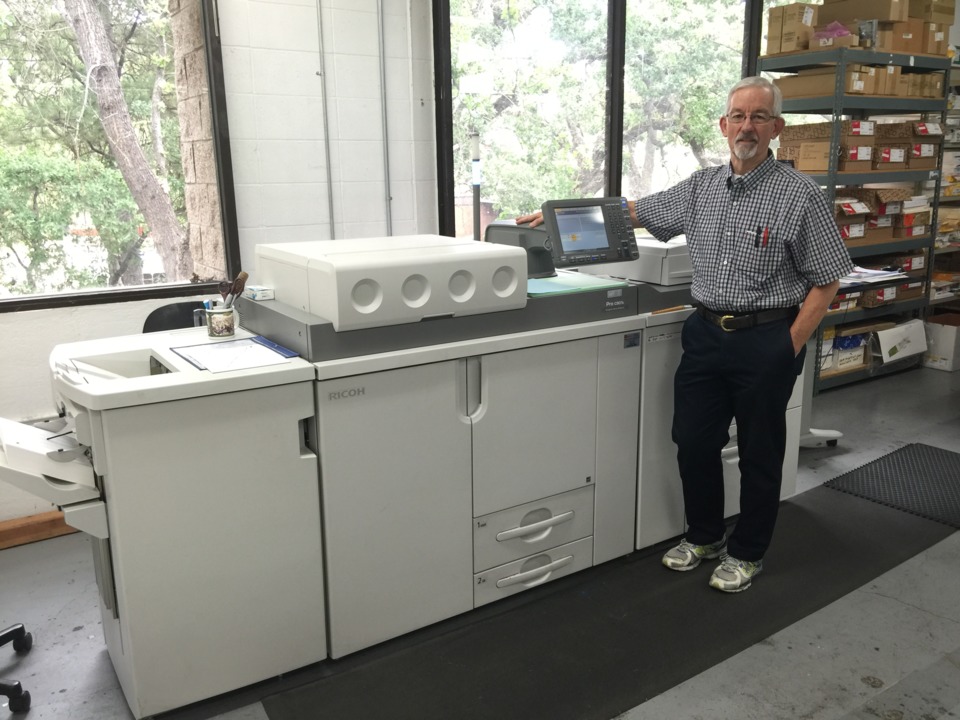
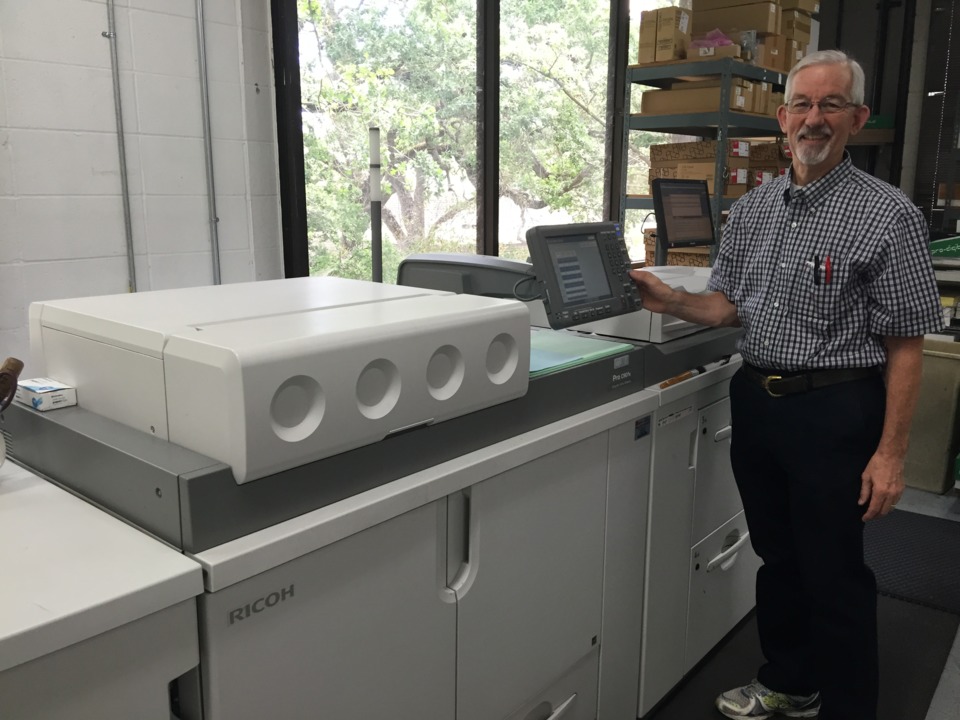
Allegro is still reaping the benefits from a piece of equipment – the Ricoh Pro C901s Color Production Printer -- that it purchased four years ago to help meet its high-volume customer demand in a very short amount of time with top quality.
“The previous piece of equipment had acceptable quality, but it broke down every 7,000 copies,” Smyth recalls. “That’s about every three or four days, so it was killing us.”
The newer unit has made a difference. “Because we know it’s not going to be down, we are able to guarantee the turnaround that if you get the files to us by noon we’ll have the brochures to you the afternoon,” Smyth explained. “In the San Francisco Bay area’s world of real estate, that is life and death. If you can’t guarantee it, the realtors go, ‘Well, I don’t know. Maybe I’ll try something else.’” Indeed, Allegro is now so reliable at meeting the deadlines that realtors are recommending the company to friends and associates.
With so many of its eggs in the real estate basket, Allegro is trying now to diversify.
“We are so reliant on real estate that it is beginning to worry us,” Smyth admitted, “so we have decided we are going to travel and meeting planning as another vertical market to focus on because they have similar requirements to the real estate market -- speed, quality and the ability to be resourceful in solving somebody’s last-minute emergency. We are putting together the marketing push to enter that market. We want to have organic growth and branch out into another vertical so that we can not be so reliant on the boom and bust that is the world of real estate.”