Aqueous, Oil, Hotmelt and UV-cured, Oh My!
From office printers to some of the biggest and fastest production inkjet machines out there, there are some common properties derived from different ingredient choices.
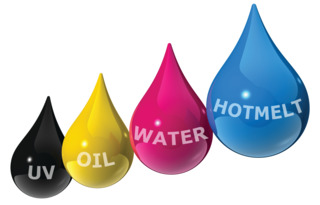
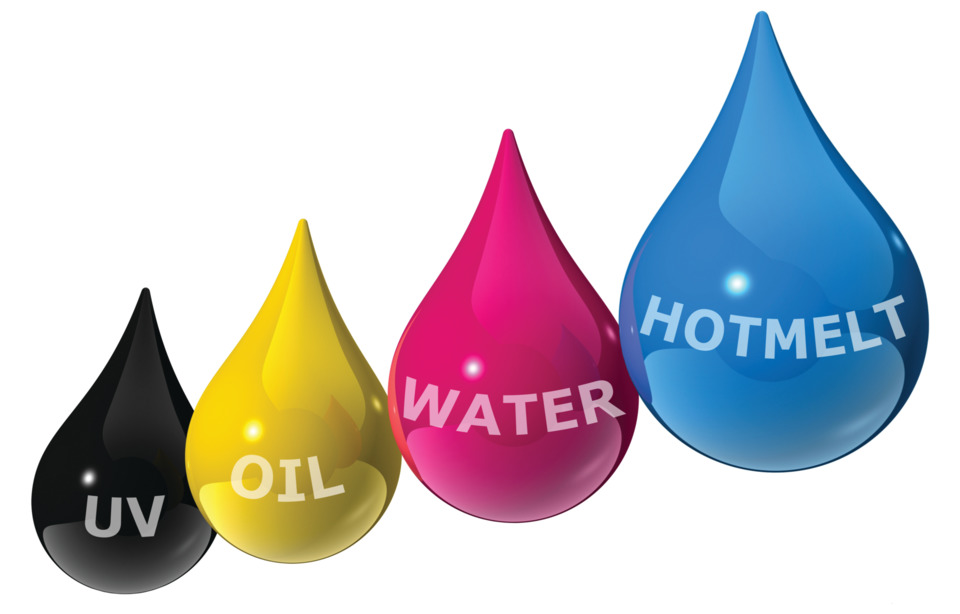
From office printers to some of the biggest and fastest production inkjet machines, there are some common properties derived from different ingredient choices. There are four main competing ink types: aqueous, oil, hotmelt and UV-cured; with each marketed as the one that gives the best color, speed or substrate tolerance.
Of these, water is by far the most common carrier used globally for inkjet inks.
Color Comes First
Regardless of ink type, one of the most important choices to be made is the colorant. Whether you have pigment or dye can make a big difference. Simply put, dyes dissolves in the ink base, whilst pigments stay as solid particles. As a result, dye is cheaper to make and incorporate into the ink and is therefore often found in lower-priced offerings. Pigment offers generally superior water resistance and UV fade resistance and so it is by far the most dominant choice these days. From a sustainability perspective, it is easier to recycle.
On the negative side, pigmented inks generally cost more per pound because those solid particles need to be dispersed somehow to keep them stable in the mixture, usually by milling. In fact, pigment dispersion technology is the key to a good inkjet ink, since it influences the color capability as well as the overall performance in the system. The manufacturing process for each ink type will be optimized differently because of the other ingredients present and the effect they have on the pigment.
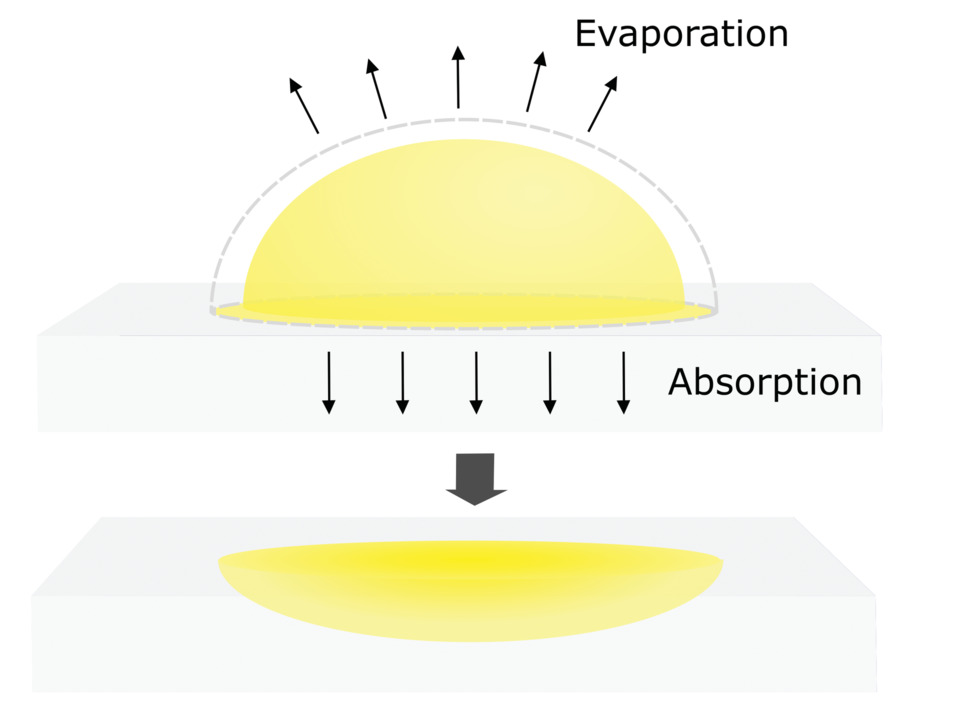
The other main difference between our four basic ink types is whether the recipes have any substantial volatile content. A lot of the key performance differences are based on how the carrier solvent absorbs and/or evaporates. Oil and water-based inks rely on these mechanisms, whilst the UV and hotmelt inks convert much more quickly from liquid to solid, thus reducing effects like ink bleed as well as paper deformation. Of course, since they do not lose any volume, the UV/hotmelt options inevitably give thicker film and can result in a different feel of the printed product.
Now that you have a general idea of the different types and colorants used, let’s talk in a little more detail about all the ingredients that can affect the behavior of ink, taking water-based as our example.
Two of the most important materials are the pigment dispersion and the resin, which give the ink its end-use properties. These are followed closely by the co-solvents and surfactant that influence the print process itself – such as drying.
Pigments vs. Dyes
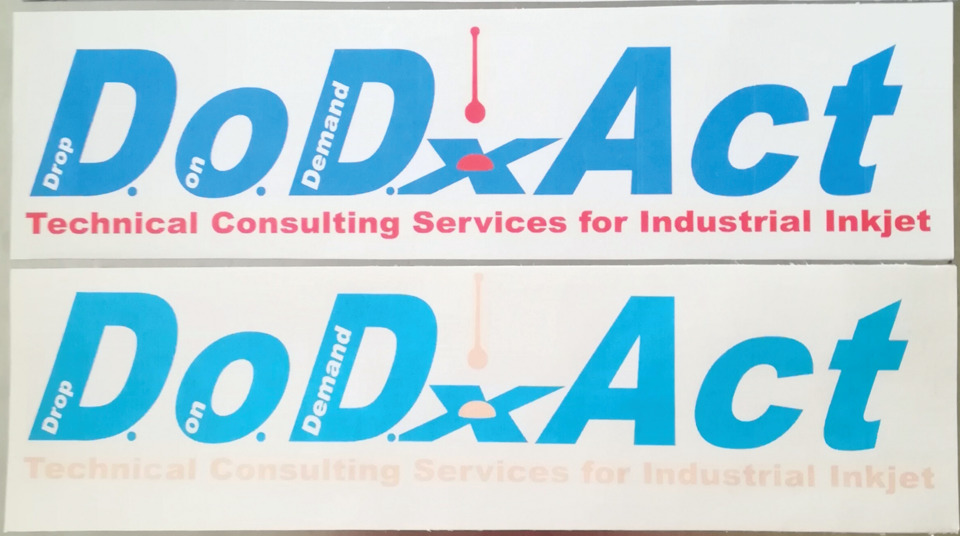
The single biggest reason pigment has replaced dye for many applications is lightfastness, also known as UV fade resistance. Dyes can develop strong colors, but the saturation of these colors can shift as the dye migrates with time and is prone to oxidative deterioration and fading under sunlight through UV exposure. Print permanence is an important consideration for the retention of records, and the increasing use of pigment colorant has helped inkjet compete with electrophotography in this respect, although the use of special coatings means dye-based inks are still use for archiving.
From an ink-making perspective, pigment colorants take more effort to produce than a dye. Usually a dye can be weighed straight into a formula and readily mixed into the base. For more difficult-to-dissolve dyes, it may be necessary to make an intermediate solution that is then weighed as a liquid. For pigments, however, the raw material powder must be dispersed into a vehicle to allow it to be milled to the desired particle size. The milling process uses complex and expensive equipment and much more energy than simply mixing in the dye. This is where the cost comes in.
Many small ink producers buy their pigment dispersions from a supplier and will simply mix them into an ink a bit like a dye. In this case, their focus will be filtration and ensuring they get the right stability with the rest of their materials by monitoring particle size, for example.
For the larger volume manufacturers, it is more cost effective to become vertically integrated and make the dispersion, or at least develop it and engage a toll manufacturer. Many inks from the best-known companies often also use proprietary material in the dispersion, thus making their technology specific to the print process. As a result, OEM’s attain complete control over the pigment dispersion formulation and many of its key performance factors. This can be a bigger security feature than any RFID chip on the container.
Resins
The main role of the resin is to act as a “binder." Resin, which refers to an ink’s polymer, forms the resistance property of the ink layer by forming a film as the water evaporates, often by some additional cross-linking. Resins reduce or eliminate print defects caused by ink rewetting/smearing.
From a jetting perspective, the resin binder is also an important viscosity modifier, since it helps the formulator balance the water content without using too much co-solvent or humectant, which can slow the drying.
A resin’s polymers are either soluble, like the dyes discussed above, or form a suspension of particles, either as a dispersion or emulsion. The term "latex" has often been used to refer to the resin in an ink, although that term is somewhat more specific than intended by many using it. Not all resins are artificial plastics; many (inkjet) inks have been made using shellac, for example, which comes from natural sources.
Of all the polymers used regularly in non-inkjet ink formulations, only a minority can be jetted, and of those, many can result in irreversible damage to the average print head. For this reason, just like for pigment dispersions, many major printer suppliers developed their own proprietary materials with the added benefit to the OEM of making them even more difficult to copy.
Humectants and Co-solvents
These materials normally represent the major component in the ink by volume (other than water). A humectant is a molecule that holds on to water and can therefore prevent evaporative loss from the nozzle. As a result, they are important for nozzle health and reliable printing. Unfortunately, they usually have a high boiling point, so as printers get faster, the amount of humectant has decreased significantly. Industrial and production inks are now quite different in this respect to office inks, which are designed to be easily kept printing-ready between long periods of being idle.
Water-soluble co-solvents also have an important role in controlling the rate of penetration into plain paper. They may also heavily influence how the resin comes out of solution and forms a film, which can also affect ink bleed. The overall result of trying to balance so many requirements is that typical inks tend to be made up of a mixture of quite a few co-solvents.
Surfactants
Since water has a very high surface tension, getting it to jet well, penetrate paper or wet-out on less-absorbent surfaces is where surfactants become important.
Surfactants are like the fairy dust of inkjet formulation, where a tiny quantity can make a massive difference to the behavior, and finding the right one can be the secret to success. This is especially the case for single-pass or “page-wide” printers because of close dependence of the print quality on the ink spread. As a result, the surfactant(s) in the ink also influence the tendency of ink to bleed.
Because they migrate to new surfaces, however, many surfactants can also stabilize foam, so it is sometimes necessary to add defoamers to the ink as a counterbalance. This means inks can have a number of different additives all at once.
Defoamers
Defoamers can be physical or chemical in nature. Either way, the intention is to break the surface of the bubbles, so they collapse. To achieve this, defoamers are generally a bit less compatible in the base. Therefore, if there are both surfactants and defoamers, then the balance can be important to avoid irregular wetting (mottle) or even pinholes. For this reason special chemical additives have been developed that try to do both these jobs.
Rheology Modifiers
We mentioned viscosity in relation to resins already. The problems is that many print heads require a viscosity much higher than water, so special additives called rheology modifiers may be used in addition to binder resin. Normally added in small quantities, these materials can increase viscosity and help the ink formulator avoid adding too much co-solvent (and affecting the dry speed). Rheological additives are common in paints too, but they have to be used very cautiously in inkjet inks because they can have different properties under the high shear condition created by the jetting process.
Biocide / Fungicide
Finally, one of the most important additives to water-based inks is the biocide/fungicide. The role of this material, which is commonly found in household cleaners, is to stop the ink from growing biologically (fungus, mold) whilst on the shelf or being transported. By their nature, the biocides are hazardous, so need to be added carefully. Typically used at very low levels, their effectiveness can be influenced by other materials, so shelf-life stability testing is an important part of aqueous ink development.
To summarize, inkjet inks are highly complex, and it takes years to fully design the chemistry balance that is needed for the type and reliability of a particular print head technology, as well as the substrate. This complexity is why each OEM ink’s chemistry is different and why warranties aren't honored if a non-approved ink is used.
Mark Bale is the founder of DoDxAct Ltd. in Somerset, U.K., where he consults in all aspects of inkjet R&D from ink formulation and manufacture through jetting and process integration to final application optimization in production inkjet, wide-format graphics, labels and packaging, decorative surfaces, photovoltaic manufacture and product coding.