Making the Investment: Toner or Inkjet?
In many ways, the so-called debate—toner vs. inkjet—mimics the offset-digital debate of 10 years ago.
As the output quality of production inkjet devices continues to improve, print service providers (PSPs) weighing their next digital printing device investment need to take a good, hard look at their business and their current and potential customers’ applications requirements.
The decision for many comes down to investing in a cut sheet, toner-based press that delivers cost-effective, short- and very short run high-quality printing with superior media flexibility or in a production continuous-feed inkjet, designed for super long runs for specific applications, offering full variable printing but with less media options, and at a more significant financial investment.
In many ways, the so-called debate—toner vs. inkjet—mimics the offset-digital debate of 10 years ago, said Frank Kanonik, principal of Intellective Solutions consultancy. “Should something be printed offset or digital was the subject of big debates. Considerations were cost, quality, run length, paper choices, availability of specialty papers, and finishing.” And economics—mostly economics.
Sound familiar?
“With inkjet and toner-based digital, it still comes down to economics, run length, paper choices, and what type, if any, specialty finishing is required,” said Kanonik.
Similar to what they did during offset-digital debate years, PSPs need to evaluate their customers’ application requirements, in terms of turnaround time, volume, image quality, and media, the cost does it take to drive it; what kind of customer satisfaction they are looking to drive, and who the end customer is, and make a determination from there, said Chris Irick, worldwide product marketing manager, High Entry Production Color, Graphic Communications Business Group, Xerox.
Higher end continuous feed inkjet devices will print well over 10 million impressions per month, while digital color press cut sheet offerings don’t exceed 400,000, Irick continued. “It’s critical to understand your customers’ volumes and turnaround times.”
If you are Time-Warner and you are printing transactional statements, requiring massive volume that has to be 100 percent accurate in a narrow window—i.e. need it by tomorrow—you will drive that project with a high-speed solution like inkjet.
In the direct mail space, however, where there may be more of a requirement on media flexibility and more concern on image quality (IQ), depending on volume requirements, if it’s a shorter run, PSPs typically gravitate toward toner, Irick explained. Especially if you have to hit a certain PMS color.
“As inkjet quickly evolves and matures in the marketplace, customers can confidently count on the fact that depending on their requirements in volume and turnaround time, they will have an option from us in the toner-inkjet space,” commented Jeff Perine, production inkjet business team, Graphic Communications Business Group, Xerox.
Making the ‘debate’ more interesting—the barrier to entry for inkjet is being lowered, noted Ed Wong, product marketing, Ricoh Production Printing Business Group, Ricoh Americas Corporation. “At GRAPH EXPO 14, Ricoh introduced a series of products that closed the gap between continuous feed inkjet and electrophotography (toner). It’s now more of a gray area in terms of quality.”
While continuous feed doesn’t support a lot of synthetics that can be printed on cut sheet, the quality gap is narrowing.
“It comes down to what is the end requirement,” said Wong. “We are offering little to no compromise on image quality and similar media capability up to 250 gsm. With the Pro VC60000, we open up the world of variable data.”
There are numerous factors to take into consideration to determine the best print technology for a print job, noted Kevin P. Kern, SVP marketing, Konica Minolta.
“Starting with the print application (direct mail, booklet, marketing collateral, etc.), I would determine the base line cost per unit,” he continued. “Production availability of equipment will also affect which device to print with. For example, your web-fed inkjet press might be in the middle of a large catalog run, so you may defer to a toner-based cut sheet machine that is sitting idle. Delivery times for production can certainly be faster with a web-fed inkjet press vs. a toner-based press.
“While the perceived quality between technologies can be subjective and dependent upon the substrate used, each technology will be limited to certain substrates,” Kern said. “For example, most web-fed inkjet presses cannot run certain synthetic stocks that could be accomplished by a toner-based press. In terms of finishing capabilities, whether it is dedicated in-line with a press or near-line will also affect the number of touches and production time drastically.”
For the PSP, there is no perfect recipe, no magic bullet to help make the decision. Vendors in this space—Canon, Ricoh, HP, Kodak, Konica Minolta, and Xerox among others, look to help their PSP customers define their business objectives.
“What we have learned in terms of customers adopting inkjet, is that it’s never a prefect formula,” said Mike Herold, director, CF Inkjet Technologies, Ricoh. “We look at their investment capability, the volume of production. We want to make sure the customer has enough volume to distribute across its inkjet device to make economic sense. We want our customers to go into the buying process eyes wide open.”
The volume of production is going to be a key driver when making the “should I go inkjet?” decision.
As with any major investment decision, the top issue is coming up with the financial model to justify the purchase. While vendors do have tools available to analyze the specifics of when to run offset, digital, or inkjet, it still comes down to having a solid financial case to implement inkjet, said Kanonik. “It depends on the application and how that application is used by the customer, and if that application will use the benefits of inkjet,” he said. “If it’s a straight postcard; nothing is personalized, might as well do it on offset or toner. Personalized direct mail and multi-page books are sweet spots for inkjet.”
But inkjet technology is changing quickly; new paper capabilities and new models are being introduced frequently, so as a printer or print buyer you have to stay up on the technology. “If you didn’t keep up with toner-based a few years ago, you were shocked at the range of paper as and quality coming off of toner presses,” Kanonik explained.
The same is now happening with inkjet.
The paper challenge is one that inkjet vendors are looking to eliminate. High-speed inkjet vendors are working with merchants and mills to come up with stocks that can receive the inks and ink configurations to meet high quality expectations.
Canon Solutions America’s media lab, located in Boca Raton, FL, works with paper partners to test a wide variety of media and optimize production performance. The result: customers now have access to hundreds of stocks from over 30 worldwide paper mills, said Eric John Hawkinson, director, marketing, Production Print Solutions, Canon Solutions America.
“In the past 18 months, we have validated 1,400 stocks to run on a variety of inkjet devices,” he said. “There is a symbiotic relationship with ink and media and it is absolutely necessary as the market leader that we have the right mixture of ink and media. That is why we invested in the lab.”
Canon also launched its global, vendor-neutral Inkjet Media Catalog. Every sheet included in the catalog is widely available in North America and has been approved for use on Océ inkjet platforms. Each is printed with the same artwork—a combination of images that demonstrates print quality across low-, mid-, and high-key photos, skin tones, solid colors, gradations, text, reverse print, and more—allowing for one-to-one comparison of sheets from 10 participating mills.
Within the traditional commercial print industry, where PSPs are more familiar with sheetfed offset, there is a perception that continuous-feed inkjet is more complex, said Perine. “If you take a look within the marking engine; the complexity of inkjet vs. toner, one of the elements that makes inkjet hugely attractive is that there are so few moving parts.”
Xerox is also looking to dispel comparisons with earlier inkjet models that delivered high volume but low image quality (IQ). “We made a quick migration from that issue—image quality is considerably better and continues to get better,” said Perine.
In the end, it all comes down to choosing the right tool for the job.
In today’s print environment, many, if not most, commercial printers rely on a mix of technologies to respond to customer applications.
One Xerox customer, Gilmore Doculink, an operating unit of R.E. Gilmore Corporation in Ottawa, ON, is a poster child for getting it right, said Irick. The company, a commercial/digital print shop that specializes in variable-data solutions, has both iGen 150 toner-based and CiPress 500 continuous-feed waterless inkjets solutions. Customers’ needs define which technology is in play—short run, custom digital on demand are run on the iGen, while high volume transactional statement are run on the CiPress. MIS software helps determine what is the best tool for the job, efficiently managing the queues and routing jobs.
“Requirements are unique to each customer, and often they require multiple technologies to accomplish their full range of customer applications,” said Herold.
“The trend going forward, said Herold, is to operate in a mixed environment, allowing PSPs to respond to their customers’ demands for “the right document, as the right price point, in the right timeframe.”
It’s really about knowing what devices can print, and setting the right expectations with the customer, Kahonik said. “Once you have the toner-based heritage or background, it’s common to then make that leap to inkjet. That would be the logical progression—developing the expertise required in a digital print environment, in terms of color management and a business model that makes sense—with a toner device, and then moving into inkjet.”
Darwill Makes The Move
Located in Hillside, IL, Darwill’s trajectory into inkjet follows a common path. A commercial printer with strong roots in offset, it began offering personalization for direct mail around 20 years, either imprinting it with black only information or running on digital cut sheet devices when they became available.
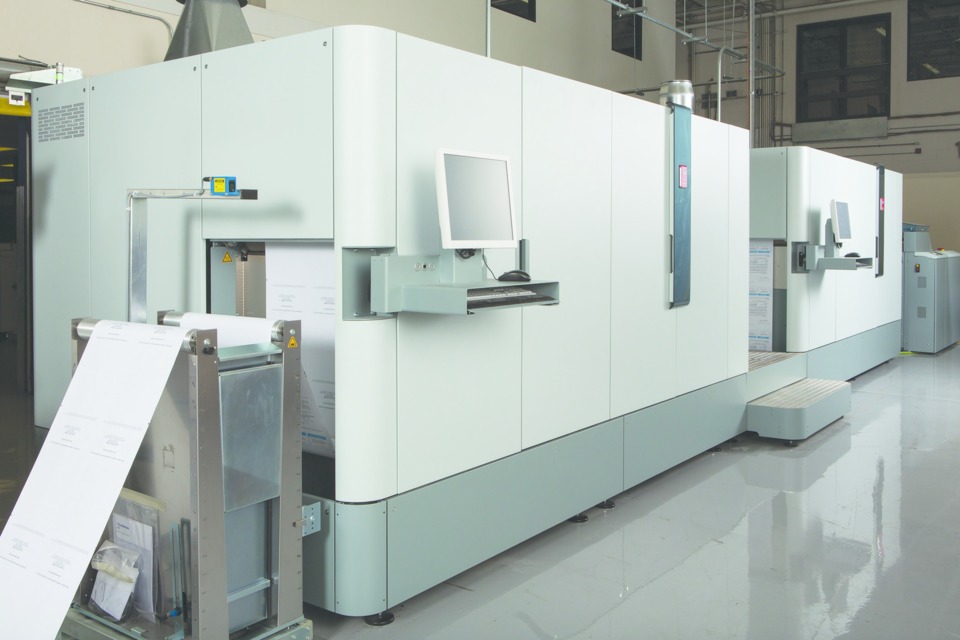
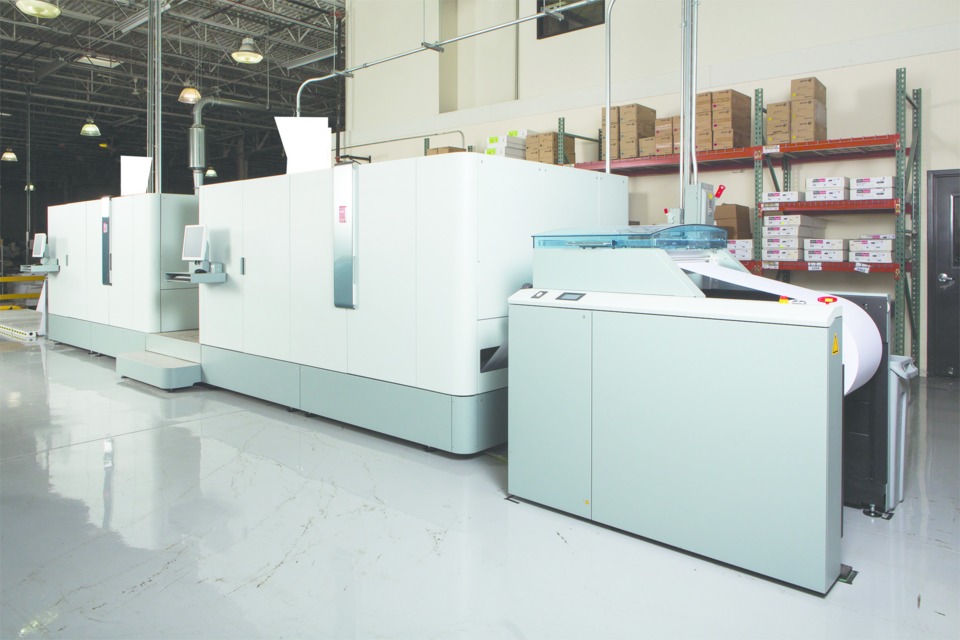
Three years ago February, the company acquired the Océ ColorStream 3500 high-speed inkjet system. “We do a lot of direct mail and that’s where we are using that equipment,” explained Mark DeBoer, director of customer experience, Darwill.
Ninety-nine percent of the work is four-color, in run lengths for 8.5x11 inch work that ranges from 30,000 up to 3.5 million.
While direct mail has always been one its product offerings, ColorStream “allows us to present four color variable option at a more reasonable cost justification for direct mail agencies or marketing departments,” said DeBoer.
The inkjet machine has allowed the company to tackle bigger runs, and provided bigger opportunities. “We can deliver a different level of versatility to our customers,” DeBoer acknowledged. “We can offer four-color variability, and change the information on the fly.”
Darwill has two ColorStreams; the second one was installed early in 2014, less than two years after the initial install. “For a place our size, it’s a pretty sizeable investment to put those two devices in our place in such a short amount of time, DeBoer said. “We are getting a lot of utilization and we can see where are we gong to put the next one; we are looking for that next opportunity to force us into having to buying another one.”
Getting up to speed also required a significant investment in workflow and staff. “Everything is faster, bigger, there’s more data that has to be crunched,” noted DeBoer. “As an emerging technology in printing space, there isn’t yet years and years of research on how to get the work out. The traditional mindset of how ink lays down on paper is entirely different than offset. Prepress staff has had to change how they’ve been trained to think; there is a new way that the image is produced and how color is managed.”
Darwill’s prepress team is up to the task. And the sales team has also picked up the gauntlet, excited to be able to offer powerful solutions and to respond to their customers’ wish lists with technology that wasn’t available before.